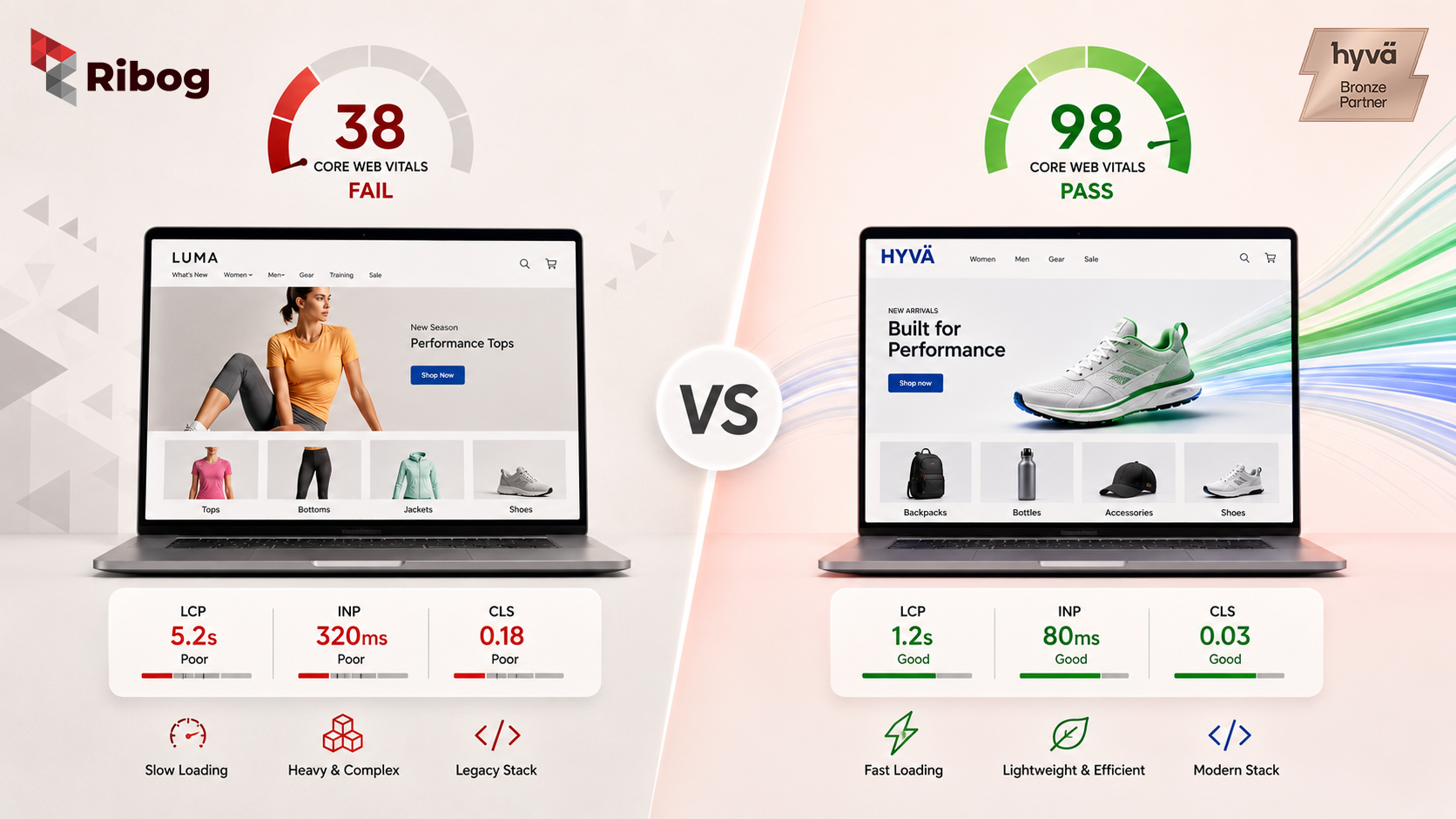
If you run a Magento 2 store, you’re almost certainly using one of two frontends: Luma, the default theme that has shipped with Magento since 2016, or Hyvä, the modern replacement that has taken over the Magento ecosystem in the last five years.
The Hyvä vs Luma question used to be a developer debate. Not anymore. Today it directly affects three things every store owner cares about: how fast your pages load, how well you rank on Google, and how many visitors actually check out.
This is a real-world comparison — not a spec sheet. We build and optimize Hyvä storefronts every week at Ribog, and we’ve migrated stores off Luma across fashion, sports merchandise, and B2B catalogs. Here’s what the difference actually looks like when real customers hit real stores.
The short answer: Hyvä loads several times faster than Luma, passes Google’s Core Web Vitals where Luma routinely fails, cuts frontend development time significantly — and since November 2025, the core theme is officially free and open source. Luma’s only remaining advantage is that it’s already installed. For most stores in 2026, the question is no longer whether to move to Hyvä, but when.
Now let’s look at why.
Luma is the default frontend theme bundled with Magento 2. When it launched in 2016, it was a reasonable choice. In 2026, it’s a decade-old architecture carrying a decade of technical debt.
The problem isn’t cosmetic — it’s structural. Luma is built on a stack of aging JavaScript technologies: Knockout.js, RequireJS, jQuery, and LESS. Every page load pulls in this entire stack, whether the page needs it or not, generating hundreds of requests per page — most of which exist to support framework overhead rather than anything your customer sees.
The result is the classic Luma experience: the page appears, then stutters, then shifts, then finally becomes clickable a few seconds later. Your customer feels it. Google measures it.
It’s also worth being honest about Luma’s future. Adobe’s development focus has moved to newer storefront technologies, and Luma has received maintenance rather than meaningful new investment for years. You can verify how Adobe structures its platform support on the official Adobe Commerce release and support schedule. Building your storefront’s future on Luma is building on a frozen foundation.
Hyvä is a complete frontend replacement for Magento 2, created in 2021 by veteran members of the Magento community. Rather than patching Luma’s problems, it deletes them: Knockout.js, RequireJS, jQuery, and LESS are gone entirely.
In their place, Hyvä uses two lightweight, modern tools: Tailwind CSS for styling, so only the CSS your store actually uses gets shipped, and Alpine.js for interactivity — a tiny JavaScript library instead of a heavy framework chain.
The numbers, published by Hyvä itself, are dramatic: compared to Luma, Hyvä achieves a 98% reduction in page requests (around 5 versus 230) and an 86% reduction in page weight (roughly 0.4 MB versus 3 MB uncompressed). The theme now powers more than 6,000 live stores, including brands like Nestlé, Volkswagen, Dunkin’ and JYSK. You can experience the difference yourself on the official Hyvä demo store — run it through Google’s PageSpeed tools and compare it with any Luma site.
And here’s the game-changer for store owners: on November 10, 2025, Hyvä’s founder announced that the Hyvä Theme is now open source and free, released under the OSL 3.0 and AFL 3.0 licenses — the same open-source licenses used by Magento Open Source itself. The €1,000-per-store fee that was once the main barrier to adoption is gone. Full technical documentation is openly available at docs.hyva.io.
Hyvä is now the de-facto standard frontend for new Magento builds, supported by a compatibility ecosystem covering every major extension vendor.
This is where Hyvä wins so decisively that it usually ends the conversation.
On identical hosting with an identical catalog, a well-built Hyvä store typically posts mobile Lighthouse scores above 90, while the same store on Luma struggles to break 40. That’s not a tuning difference — it’s architectural. Luma cannot ship less JavaScript than its framework stack requires. Hyvä simply doesn’t have that stack.
Google evaluates every site against Core Web Vitals, its official set of user-experience metrics. Three numbers matter, and Google publishes the thresholds openly: Largest Contentful Paint (LCP) should occur within 2.5 seconds, Interaction to Next Paint (INP) should stay under 200 milliseconds, and Cumulative Layout Shift (CLS) should remain below 0.1. In our experience, Luma stores commonly land at 4–6 seconds LCP on mobile and fail INP because of their JavaScript chain, while properly built Hyvä stores clear all three thresholds comfortably — the near-empty JavaScript payload keeps interactions instant and layouts stable.
Why should a store owner care about lab metrics? Because speed converts. Google’s own published research on mobile page speed found that the probability of a visitor bouncing rises sharply with every additional second of load time. On mobile — where most of your traffic lives — Luma is regularly on the wrong side of that line. Hyvä isn’t.
We’ve seen this pattern first-hand on the high-traffic builds we’ve covered in our sports merchandise and fashion store breakdowns: same products, same hosting, transformed performance.
Winner: Hyvä, by a landslide.
Speed and SEO are no longer separate topics. Google’s official documentation confirms that page experience — including Core Web Vitals — is used in ranking, which means Luma’s failing scores are a quiet drag on your rankings every single day.
But there’s a second, less discussed SEO advantage: crawlability and rendering. Hyvä pages are server-rendered, clean HTML with minimal JavaScript. Search engine crawlers — and increasingly, AI shopping agents and answer engines — parse them quickly and reliably. Luma’s JavaScript-heavy pages are slower to render and costlier to crawl, which can affect crawl budget on large catalogs.
As search shifts toward AI-driven results, lightweight, semantically clean storefronts are better positioned to be read, understood, and recommended by machines. That’s a structural advantage Hyvä holds and Luma never will.
Winner: Hyvä.
For years, the honest case for Luma was simple: it’s free, Hyvä costs €1,000 per store. That argument is now dead. Per the official announcement on hyva.io, the Hyvä Theme itself is free — available on GitHub and via free Composer keys through the Hyvä Portal.
Luma’s “free,” on the other hand, is misleading. You pay for it continuously through slower development (every customization fights the legacy stack), performance-optimization work that never quite fixes the architecture, higher hosting demands, and — most expensively — lost conversions from slow pages. Luma is free the way an old car with terrible mileage is free.
Hyvä’s real costs sit in implementation, not licensing. The migration or build itself is the main investment — typically a few weeks of development depending on your customizations and extension list. Beyond that, Hyvä offers optional commercial products for stores that want them: per the announcement, Hyvä UI, the ready-made component library, is priced at €250 per store, while Hyvä Checkout and the enterprise-tier products remain separate paid offerings — full terms are published in the official Hyvä license agreement. None of these are required to run a fast Hyvä storefront.
Factor in the development-time savings Hyvä reports from its ecosystem — commonly cited at 20–50% versus Luma — and the total cost of ownership tilts clearly toward Hyvä within the first year for most stores.
Winner: Hyvä — and this round flipped completely in November 2025.
The strongest historical argument for Luma was compatibility: every Magento extension ever written works with it, because it’s the default.
In 2026, this gap has largely closed. The Hyvä compatibility ecosystem now spans thousands of modules — the Hyvä compatibility module tracker lists coverage across all major vendors, and since the open-source relicensing, extension developers can ship Hyvä support under OSL 3.0 without licensing friction, which has accelerated adoption further. For the rare extension without official support, an experienced Hyvä agency can build a compatibility layer, usually in days, not weeks.
The practical guidance: audit your extension list before migrating. In our migrations, the overwhelming majority of a typical store’s extensions have ready-made Hyvä support, and the audit itself takes an afternoon.
Winner: Luma on paper, Hyvä in practice — and the gap shrinks monthly.
Ask any Magento developer which frontend they’d rather work in. You’ll get one answer.
Tailwind CSS and Alpine.js are among the most widely adopted tools in modern web development, which means the pool of developers who can work productively on Hyvä is large and growing. Luma’s stack — Knockout, RequireJS — is a legacy specialty that fewer developers learn each year. That scarcity shows up directly in your agency invoices and hiring timelines.
Then there’s the roadmap question. Hyvä is actively developed, with regular releases, public documentation at docs.hyva.io, and a commercial ecosystem that funds continued work on the free core. Luma receives maintenance patches. When you build on Luma in 2026, you’re investing in a frontend with no future roadmap. Every rupee, dollar, or euro spent customizing Luma is spent on borrowed time.
Winner: Hyvä.
An honest comparison needs an honest answer here. Staying on Luma is defensible in exactly three situations.
First, you’re replatforming soon anyway. If you’re leaving Magento within six to twelve months, don’t invest in a frontend migration. Second, you depend on heavily customized legacy modules with deep Luma frontend entanglement, where the rebuild cost genuinely exceeds the performance payoff — rare, but real for some older B2B builds. Third, your store is trivially small and traffic is negligible, so conversion gains can’t repay even a modest migration.
If none of these describe you — and for most growing stores, none do — the case for Luma has run out.
A common fear: “won’t this break my store?” A Hyvä migration done properly doesn’t touch your backend at all. Your products, orders, customers, admin panel, integrations, and data stay exactly where they are — only the frontend theme layer is rebuilt.
Our typical process at Ribog runs in four stages. We start with an audit of your extensions, customizations, and design inventory, and tell you upfront what needs compatibility work. Then comes the build — Hyvä theme development on a staging environment while your live store runs untouched. Next is testing: full QA across devices, checkout flows, and third-party integrations. Finally, launch — a DNS-level cutover with instant rollback available.
Most stores go live on Hyvä in four to eight weeks depending on design complexity — often alongside a Magento version upgrade, since doing both together saves testing effort. (Migrating from another platform entirely? See our WooCommerce to Magento with Hyvä guide.)
Across the five rounds that matter — speed and Core Web Vitals, SEO and AI-search readiness, total cost of ownership, extension compatibility, and development speed — Hyvä takes four outright, and Luma’s sole remaining edge in extension compatibility is nearly gone.
Luma was a fine frontend for 2016. Hyvä is the frontend for 2026. It’s faster in every measurable way, cheaper to own than it has ever been, backed by an ecosystem that has become the Magento standard — and since the theme went open source, the last serious objection to adopting it disappeared.
If your store still runs Luma, you’re not just leaving speed on the table. You’re leaving rankings, conversions, and development budget there too.
Want to know exactly what a Hyvä migration would look like for your store? Talk to our Hyvä team — we’ll audit your extensions and give you a realistic timeline and quote, no obligation. Or explore our Hyvä theme development services to see how we build them.
How Ribog Can Help
At Ribog, Hyvä isn’t one of many services — it’s what we specialize in. As a dedicated Adobe Commerce and Hyvä development agency, we handle the entire journey from Luma to Hyvä: a free extension and compatibility audit upfront, pixel-perfect theme development that preserves (or upgrades) your brand’s design, compatibility modules for any extensions that need them, and a staged, zero-downtime launch with full QA across devices and checkout flows. We’ve built Hyvä storefronts for fashion, sports merchandise, and B2B catalogs, and we routinely pair migrations with Magento version upgrades so you only pay for one testing cycle instead of two. Whether you need a complete Luma-to-Hyvä migration or a performance rescue on an existing build, our team delivers storefronts that pass Core Web Vitals on day one — get your free migration audit here.
Is Hyvä really free now? Yes. On November 10, 2025, Hyvä officially announced that the core theme is free and open source under OSL 3.0 and AFL 3.0 — the same licenses as Magento Open Source. Optional paid products like Hyvä UI and Hyvä Checkout exist, but neither is required to run a fast Hyvä storefront. Your real investment is the implementation work, not the software.
How much faster is Hyvä than Luma, really? According to Hyvä’s own published figures, the theme delivers a 98% reduction in page requests (around 5 versus Luma’s 230) and an 86% reduction in page weight. In practice, that translates to mobile Lighthouse scores above 90 versus Luma’s typical 20–40, and passing Google’s Core Web Vitals thresholds where Luma fails. You can test the official Hyvä demo yourself in PageSpeed Insights.
Does page speed really affect my Google rankings? Yes. Google’s official page experience documentation confirms that Core Web Vitals are used in ranking. A frontend that consistently fails these metrics — as Luma commonly does on mobile — works against your SEO every day.
Will my existing Magento extensions work with Hyvä? Most will. All major extension vendors provide Hyvä-compatible versions or compatibility modules, and the ecosystem now spans thousands of extensions — accelerated further by the open-source relicensing, which lets vendors ship Hyvä support without licensing friction. Always start a migration with an extension audit.
Does moving to Hyvä affect my products, orders, or customer data? No. Hyvä replaces only the frontend theme layer. Your Magento backend — catalog, orders, customers, admin, ERP and PIM integrations — is untouched. A proper migration is built on staging and launched with zero data risk.
How long does a Luma to Hyvä migration take? Typically four to eight weeks for most stores, depending on design complexity and the number of extensions needing compatibility work. Large or heavily customized B2B stores may take longer. The build happens on staging, so your live store keeps selling throughout.
Is Luma being discontinued? Adobe has not announced a formal end-of-life date for Luma, but it has received no meaningful development in years — only maintenance — while Adobe’s platform investment has moved elsewhere (see the official Adobe Commerce release schedule). The Magento ecosystem, extension vendors, and community direction have all moved to modern frontends, with Hyvä as the standard.
Should I upgrade Magento or migrate to Hyvä first? Ideally, together. Since both require a full testing cycle, combining a version upgrade with the Hyvä migration saves significant QA effort and cost. Ask your agency to scope them as one project.