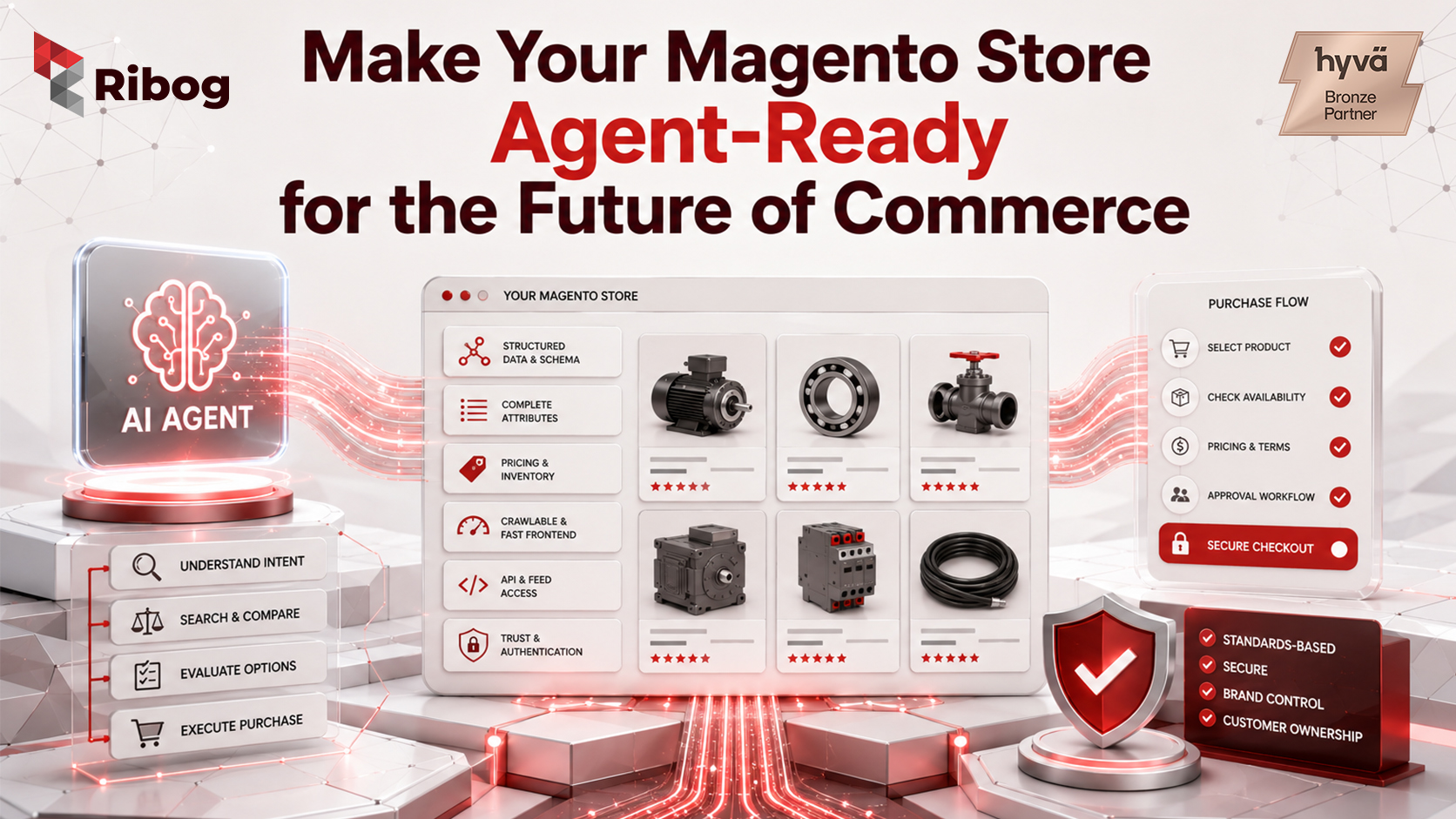
For twenty-five years, eCommerce has been designed around one assumption: a human being browses your store, compares your products, and clicks “buy.” That assumption is now breaking. Increasingly, the entity doing the researching, comparing, and shortlisting is an AI agent acting on a buyer’s behalf — and by the time a human reaches your product page, if they reach it at all, the shortlist has already been made.
This is agentic commerce, and it stopped being speculative in February 2026, when Adobe officially committed Adobe Commerce to supporting the Universal Commerce Protocol (UCP) and the Agentic Commerce Protocol (ACP) — open standards that let brands appear across AI-driven shopping channels while keeping control of their customer relationships, branding, and commerce data. When the platform vendor itself restructures around a behavior, it’s no longer a trend to watch. It’s infrastructure to prepare for.
For B2B merchants, the stakes are arguably higher than in retail. Your buyers already navigate more friction than consumers — complex catalogs, tiered pricing, approval workflows — which is precisely the kind of tedium buyers delegate to AI first. This post explains what agentic commerce actually is, what Adobe’s own data says about it, and the practical steps to make a Magento or Adobe Commerce store readable by AI buyers.
Agentic commerce is a buying model in which an AI agent — inside ChatGPT, Gemini, Copilot, or a company’s own procurement tooling — acts across the entire journey. It interprets an intent (“restock this consumable at the best landed cost with delivery this week”), searches multiple sources, evaluates options against the buyer’s criteria, and in a growing number of cases executes the transaction.
The critical difference from traditional eCommerce isn’t cosmetic. A human shopper forgives a confusing product page; they scroll, squint, and infer. An AI agent doesn’t infer — it parses. If your product data isn’t structured, complete, and machine-readable, the agent doesn’t struggle with your store. It skips your store and recommends a competitor whose data it can read.
Adobe’s own framing makes the shift explicit: the company describes agentic shopping not as a niche trend but as “the new front door for commerce” — a structural change in where buying begins, how intent is expressed, and how transactions are executed.
The numbers behind Adobe’s commitment come from its own measurement of real storefront traffic, and they’re worth quoting in any board conversation about this topic.
During the 2025 holiday season, generative AI tools drove a 693% increase in traffic to retail sites, as shoppers turned to LLMs not merely as entry points but to compare products, narrow choices, and make purchase decisions. And this traffic isn’t just voluminous — it’s better. According to the Adobe Digital Insights Report from January 2026, AI referrals convert 31% higher, generate 254% more revenue per visit, and bring shoppers who spend 45% more time on site.
The behavioral shift extends beyond discovery. Adobe’s AI & Digital Trends 2026 research found practitioners expecting most or all customer interactions to be handled by agentic AI within 18 months in areas like content recommendations, post-purchase support, and conversational engagement — and the same research found nearly half of consumers would use AI for personalized product recommendations, with 44% relying on it for instant customer service.
Retail feels this first, but B2B follows fast — procurement is exactly the repetitive, criteria-driven, compliance-bound buying activity that AI agents are built for. When your customer’s purchasing team adopts an AI assistant, your store either speaks its language or loses the order silently.
Here’s the uncomfortable test: could a machine, with no human intuition, extract from your store what your product is, what it costs, whether it’s in stock, and how it compares to alternatives? For most B2B stores on Magento, the honest answer is “partially.” These are the six layers to audit.
Structured data and schema markup. AI agents lean heavily on schema.org Product, Offer, and AggregateRating markup, machine-readable specification tables, and clean category hierarchies. If your product specs live inside a JPEG spec sheet or a free-text description block, they’re invisible to an agent. Every attribute a buyer filters on — material, dimensions, certification, compatibility — should exist as an actual structured attribute, not prose.
Complete, disambiguated product attributes. B2B catalogs are notorious for internal shorthand: SKUs as names, abbreviations only your sales team understands, variants buried in PDF datasheets. An agent comparing you against a competitor rewards whoever states use cases, substitutes, and compatibility explicitly. This is unglamorous catalog work, and it’s now a revenue activity.
Accurate, accessible pricing and inventory signals. Adobe’s stated goal for the agentic standards is engaging shoppers across LLM-based interfaces with accurate, real-time product data, and enabling secure in-agent checkout through standards-aligned payment flows. For B2B this raises a genuine strategic question — how much of your tiered or negotiated pricing to expose publicly — but the baseline is that list pricing, availability, and lead times must be readable somewhere an agent can reach, or you’re excluded from the comparison entirely.
A crawlable, fast, semantically clean frontend. Agents access your store the way crawlers do: they read your HTML. A storefront built on clean markup with server-rendered content is dramatically easier to parse than one hiding content behind heavy JavaScript. This is where a Hyvä storefront quietly earns double value — the same lean architecture that delivers speed for humans delivers legibility for machines.
Clean APIs on a current platform. Standards like UCP and ACP work through structured interfaces, and Adobe’s approach emphasizes standardized interfaces and reusable integrations to scale agentic interactions without one-off custom builds. Practically, this means the platform foundation matters: a patched, current Magento with well-maintained GraphQL and REST endpoints is the prerequisite for everything above. If you’re still on an unsupported version, the Magento 2.4.9 upgrade is the first move, not an afterthought.
Consistent data across systems. An agent that finds one price on your storefront, another in your feed, and a third in a marketplace listing learns not to trust you. For most B2B merchants, that consistency problem is really an ERP integration problem — pricing, stock, and product data must sync reliably from the system of record outward.
The encouraging part of Adobe’s announcement is who carries the protocol burden: Adobe has stated it is committed to supporting current and emerging agentic standards so brands don’t have to, freeing them to invest in richer product experiences.
Your job isn’t implementing UCP or ACP — it’s making your store worth connecting to them. Start with a catalog audit: pick your twenty best-selling products and check each against the readability layers above — structured attributes, schema markup, spec data outside of images, accurate stock signals. Fix the template-level gaps first, since schema markup and semantic HTML fixes propagate across the whole catalog at once. Then work through attribute enrichment product by product, prioritized by revenue. In parallel, get the foundation right: a supported Magento version, healthy APIs, and synchronized ERP data.
None of this is wasted if agentic adoption moves slower than predicted — every step also improves your conventional SEO, conversion rate, and feed quality today. That’s what makes agentic readiness unusual among tech trends: the preparation pays for itself even in the world where the trend stalls.
Your existing B2B feature investments compound here too. Shared catalogs, company accounts, and quote workflows are exactly the structured, rules-based buying logic that agent-driven procurement will eventually plug into.
Ribog Digital is a specialist Adobe Commerce and Hyvä agency for B2B merchants, and AI readability sits at the intersection of the three things we do daily: structured catalog work, high-performance Hyvä frontends, and ERP-integrated Magento builds.
AI-readability audit. We assess your store the way an agent sees it — schema coverage, attribute completeness, markup quality, API health, and data consistency across storefront and ERP — and give you a prioritized findings report tied to your best-selling products.
Structured data and catalog enrichment. We implement schema.org markup at template level, restructure specification data into machine-readable attributes, and set up the catalog governance that keeps new products AI-legible by default.
Hyvä frontends built for both audiences. Our Hyvä implementations deliver the semantic, server-rendered markup that agents parse cleanly and the sub-second experiences humans convert on — one investment, two audiences.
Platform foundation work. From 2.4.9 upgrades to ERP data synchronization, we make sure the infrastructure underneath your agentic readiness is current, secure, and consistent.
Book a free AI-readability review — we’ll show you exactly what an AI buyer can and can’t read on your store today.
What is agentic commerce? Agentic commerce is a buying model where AI agents — in tools like ChatGPT or Gemini — research, compare, and increasingly execute purchases on a buyer’s behalf. Adobe describes it as a structural shift in where buying begins, not a passing trend.
What are UCP and ACP? The Universal Commerce Protocol and Agentic Commerce Protocol are open standards for AI-led shopping that Adobe Commerce officially committed to supporting in February 2026. They enable real-time product data access and secure in-agent checkout while merchants retain control of customer relationships and data.
Does agentic commerce matter for B2B, or only retail? Retail is feeling it first, but B2B procurement — repetitive, criteria-driven, compliance-bound purchasing — is a natural fit for AI delegation. B2B merchants whose catalogs aren’t machine-readable risk silent exclusion from agent-built shortlists.
Do I need Adobe Commerce as a Cloud Service to participate? No. The foundational work — structured data, complete attributes, clean APIs, a supported platform version, consistent ERP-synced data — applies to Magento Open Source and Adobe Commerce alike, and improves SEO and conversion regardless of which agentic tools you adopt later.
How do I make my Magento store readable by AI agents? Start with schema.org Product markup, move specifications out of images into structured attributes, ensure pricing and stock signals are accurate and accessible, run a clean semantic frontend, and keep your platform version and APIs current.