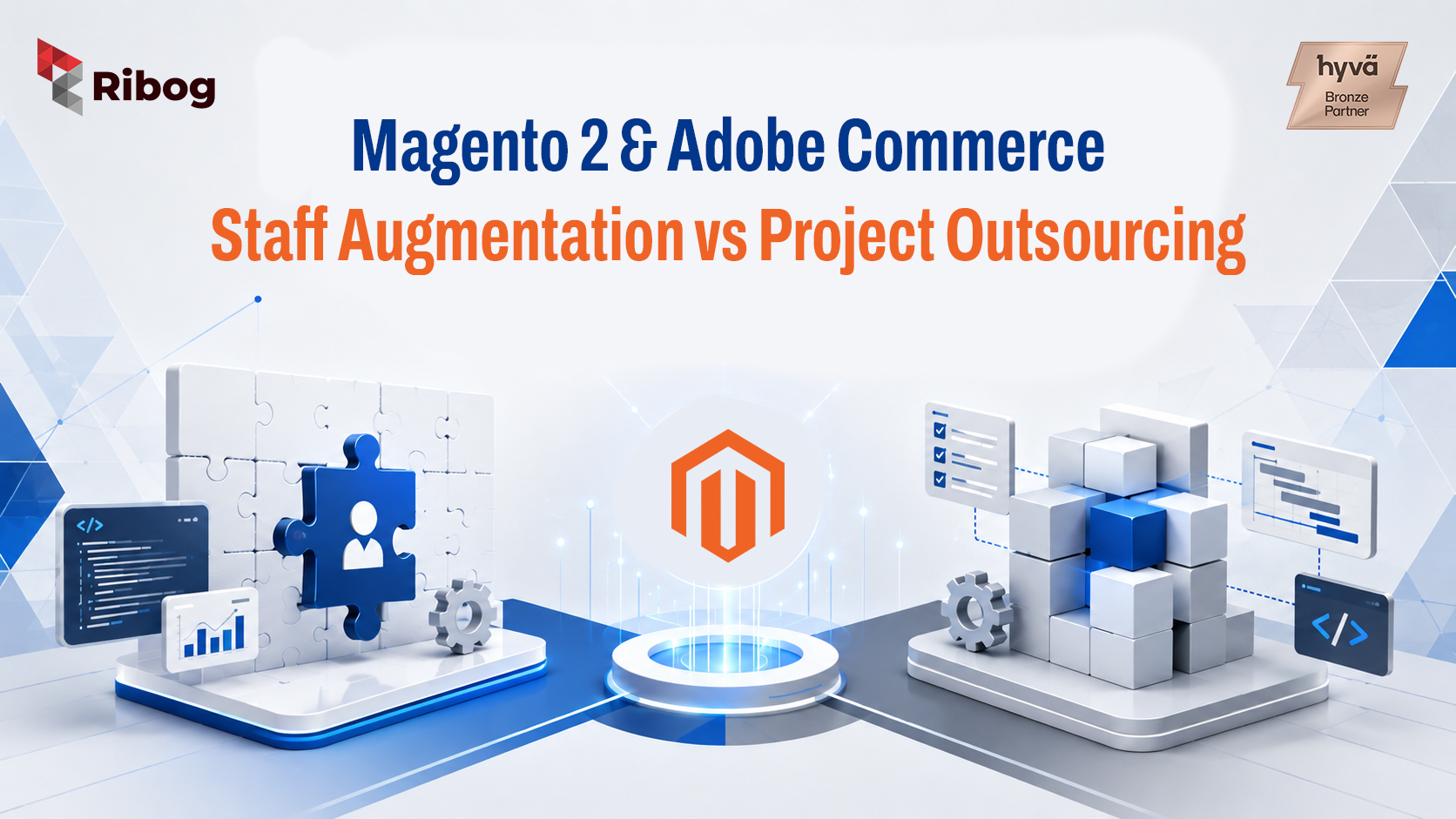
For Magento and Adobe Commerce projects, the best engagement model depends on how much control, flexibility, and predictability your business needs.
For CTOs, Heads of Digital, eCommerce Managers, and Engineering Managers, the key question is simple: do you need long-term development capacity, flexible project support, or a fixed-scope delivery?
Magento Open Source and Adobe Commerce are powerful eCommerce platforms, but they require specialist development knowledge. Adobe Commerce supports complex B2C and B2B commerce, multi-brand operations, integrations, personalization, composable architecture, and scalable digital commerce experiences through Adobe Commerce.
That flexibility is valuable, but it also creates technical complexity.
Magento/Adobe Commerce projects often include:
When these tasks are handled by generalist developers without deep Magento experience, delivery can slow down. Backlogs grow, releases become risky, and commercial rollouts get delayed.
That is why choosing the right development model matters.
Hiring a dedicated Magento/Adobe Commerce developer through staff augmentation means adding an external specialist directly into your existing team.
This model is ideal for businesses that want to expand their in-house development capacity without hiring full-time employees.
A dedicated developer works inside your workflow, using your tools, sprint process, communication channels, and code review system.
This model is best for:
Key benefits include:
A dedicated Magento/Adobe Commerce developer can help with:
This model works especially well when your internal team understands the business, but lacks enough Magento-specific capacity to move quickly.
The Time and Material model is suited for Magento/Adobe Commerce projects where the scope is flexible or still evolving.
In this model, you pay for the actual time and resources spent on the project. It gives your business the freedom to adjust priorities, add features, refine requirements, and respond to technical discoveries during development.
This model is best for:
Key benefits include:
The Time and Material model is a strong fit for Magento/Adobe Commerce because many projects reveal new technical needs during development.
For example, a checkout improvement may uncover third-party extension conflicts. A performance project may require frontend, backend, cache, and infrastructure changes. An integration project may need adjustments after testing real ERP or PIM data.
Adobe Commerce cloud deployment itself involves build, deploy, and post-deploy phases, as explained in Adobe’s official deployment process documentation. For evolving projects, this makes flexibility important.
The Fixed Cost model is best for Magento/Adobe Commerce projects with clear requirements, fixed deliverables, and a defined timeline.
In this model, the project cost is agreed upfront. The development partner estimates the work based on a documented scope and delivers according to the agreed plan.
This model is best for:
Key benefits include:
A fixed cost model works well when there is little ambiguity. However, it is less suitable when requirements may change frequently.
For Magento/Adobe Commerce, fixed cost projects should have:
Adobe recommends testing deployments on staging before moving to production in its official guide for deploying to staging and production. This should be considered while planning fixed-scope delivery timelines.
Choose Hire Dedicated Developer / Staff Augmentation if:
Choose Time and Material Based Model if:
Choose Fixed Cost Based Model if:
Many Magento merchants are now using Hyvä to improve frontend performance and simplify development.
Hyvä’s official documentation describes Hyvä Themes as a Magento frontend built from scratch using Magento’s templating system, while removing older frontend complexity such as UI components, Knockout, RequireJS, and Less CSS. You can read this in Hyvä’s official guide: What is Hyvä?.
An embedded Hyvä frontend specialist can help with:
.phtml templatesHyvä also provides official performance guidance covering images, JavaScript, CSS, DOM size, and Core Web Vitals in its Hyvä performance documentation.
For businesses using Hyvä, choosing the right model is important. A dedicated Hyvä specialist may be better for ongoing frontend work, while fixed cost may work for a clearly defined Hyvä component or page build.
Adobe Commerce development is not only about coding. It also involves cloud environments, deployment workflows, configuration, patches, integrations, and performance planning.
Adobe’s official documentation explains that Adobe Commerce deployment includes build, deploy, and post-deploy phases in its deployment process guide.
Adobe also provides official developer tools such as Cloud CLI, Cloud Docker for Commerce, Cloud Patches, ECE-Tools, and integrations in its developer tools overview.
This means your Magento/Adobe Commerce developer should understand:
Adobe also recommends testing patches in staging or development environments before deploying to production in its guide on how patches work.
For enterprise and mid-market eCommerce projects, certification is an important signal of technical credibility. A certified Magento/Adobe Commerce developer has validated knowledge of platform architecture, development standards, customization methods, and best practices.
Adobe offers official Adobe Commerce certifications through the Adobe Digital Experience Certification Program. These certifications help identify professionals with proven skills across Adobe Experience Cloud products, including Adobe Commerce.
Certified Magento/Adobe Commerce developers can add value in areas such as:
For CTOs, Heads of Digital, and Engineering Managers, working with certified developers can reduce technical uncertainty. Certification does not replace real project experience, but it helps confirm that the developer understands Adobe Commerce standards and platform expectations.
When choosing between Staff Augmentation, Time and Material, or Fixed Cost models, certified developers are especially useful for:
Ribog helps eCommerce businesses scale their Magento and Adobe Commerce development capacity through flexible engagement models.
You can work with Ribog through:
Whether you need Adobe Commerce support, Magento development, Hyvä frontend expertise, checkout improvements, performance optimization, or ongoing maintenance, Ribog can help you choose the right model.
Clear your development backlog without recruitment friction. Hire a dedicated certified Magento/Adobe Commerce or Hyvä specialist from Ribog.
Magento/Adobe Commerce staff augmentation is a model where a dedicated developer joins your in-house team as an external specialist. The developer works inside your existing workflow to support ongoing development, maintenance, backlog clearance, and platform improvements.
For ongoing Magento or Adobe Commerce development, the Hire Dedicated Developer / Staff Augmentation model is usually best because it gives your team long-term specialist capacity and full control over priorities.
Choose a Time and Material model when your Magento/Adobe Commerce project has evolving requirements, changing priorities, or uncertain technical scope. It is useful for agile development, integrations, support, and continuous enhancements.
Choose a Fixed Cost model when your project requirements, scope, timeline, and deliverables are clearly defined. It is best for predictable Magento/Adobe Commerce tasks with limited uncertainty.
Adobe Commerce is the enterprise commerce platform from Adobe, built on Magento technology. Magento Open Source is the open-source version, while Adobe Commerce includes additional enterprise features, cloud capabilities, and support options.
Businesses need dedicated Magento/Adobe Commerce developers because the platform involves specialized work across modules, checkout, integrations, deployment, performance, security patches, and frontend frameworks like Hyvä.
Yes. Ribog can support Magento and Adobe Commerce teams with Hyvä frontend specialists for theme development, performance improvements, compatibility work, and frontend customization.