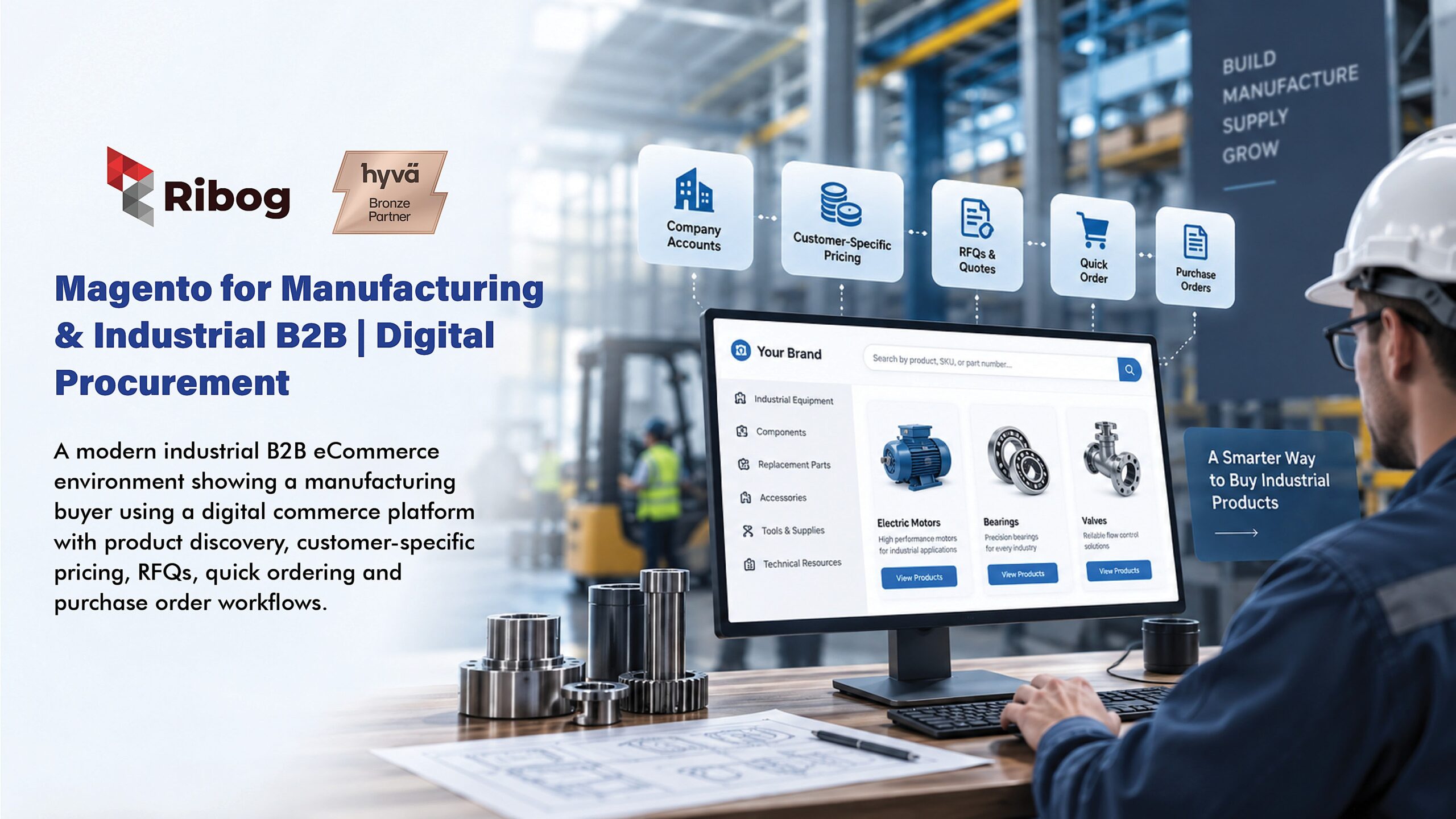
Manufacturing and industrial B2B eCommerce is very different from traditional retail. Buyers often deal with thousands of SKUs, technical specifications, customer-specific pricing, bulk orders, purchase orders, quotations, approval workflows and repeat purchases.
A manufacturing website therefore needs to do more than display products. It needs to help buyers find the right products, understand specifications, request pricing, place orders and manage procurement efficiently.
Adobe Commerce provides B2B features such as company accounts, shared catalogs, Quick Order, negotiable quotes, purchase orders and requisition lists, giving manufacturers the tools to build a more structured digital procurement experience.
For manufacturers looking to move beyond a traditional online catalog, Magento and Adobe Commerce can provide a flexible foundation for creating a connected B2B commerce and procurement platform.
A typical B2C customer may visit an online store, search for a product, add it to a cart and complete payment.
Industrial buyers often follow a much more complex journey.
A procurement manager may need to:
This means an industrial eCommerce platform needs to support procurement workflows, not simply online checkout.
Adobe’s current manufacturing solution focuses on challenges including complex product configuration, distributor enablement, aftermarket service and connected digital commerce experiences, showing why manufacturing commerce requires more sophisticated digital experiences than standard retail.
A modern manufacturing eCommerce platform should connect product information, customers, pricing and purchasing processes in one digital environment.
Important capabilities can include:
The Adobe Commerce B2B guide includes company accounts, shared catalogs, Quick Order, purchase orders, quotes and requisition lists as core B2B capabilities.
The combination of these features can help manufacturers move from a basic product website toward a more complete digital procurement environment.
Manufacturers and industrial suppliers frequently manage large and technically complex product catalogs.
A single product may have:
For example, an industrial equipment manufacturer may sell hundreds of machine models alongside thousands of components and replacement parts.
The challenge is not simply uploading these products to Magento. The real challenge is structuring the information so buyers can quickly understand what they are purchasing.
A manufacturing Magento store can be structured around:
A well-organized catalog can turn a complicated product database into a much easier buying experience.
Industrial buyers usually know what they need, but they may search for it using different terminology.
One buyer might search by product name.
Another might search by SKU.
Another could search by part number.
Another may use a technical specification.
This makes search particularly important for manufacturing eCommerce.
Manufacturers can use Adobe Commerce catalog search capabilities to configure how customers search for and discover products, helping buyers navigate large product catalogs more efficiently.
For industrial stores, search can be optimized around:
The goal is simple: help the buyer find the correct product with as few steps as possible.
Manufacturers rarely sell every product to every customer at exactly the same price.
A distributor may have one pricing agreement, while a large enterprise customer may have another.
A regional dealer may only be allowed to purchase selected products.
A strategic customer may also have negotiated discounts based on annual purchasing volume.
This is where Magento B2B functionality becomes particularly valuable.
With Adobe Commerce Shared Catalogs, manufacturers can create custom product selections and pricing for different companies, allowing different business customers to access the products and prices relevant to them.
For example:
This makes it possible to create a B2B storefront that reflects how manufacturers actually sell rather than forcing every customer into the same retail-style experience.
Manufacturing purchases are rarely made by one person working independently.
A typical organization may have:
Adobe Commerce Company Accounts allow B2B organizations to manage multiple users and permissions within a company account, making it possible to structure purchasing access around different roles.
A manufacturing organization could structure its account like this:
Company
↓
Procurement Manager
↓
Purchasing Users
↓
Approvers
Instead of employees sharing a single login, different users can have access based on their responsibilities.
This can be particularly useful for organizations with multiple departments, branches or purchasing teams.
Not every B2B buyer wants to browse an entire catalog.
Experienced procurement professionals often already know the exact SKUs they need.
For example:
Entering each product individually through normal product browsing can be inefficient.
Adobe Commerce Quick Order allows customers to enter product names or SKUs directly to create orders more quickly, making it particularly useful for buyers who already know the products they need.
For manufacturing and industrial businesses, this can be useful for:
The result is a purchasing experience designed around professional procurement rather than casual shopping.
Many industrial companies repeatedly purchase the same products.
For example, a factory may regularly purchase:
Instead of rebuilding the same order every time, buyers can use Adobe Commerce Requisition Lists to save frequently purchased products and add them to the cart again when needed.
A buyer could create lists such as:
Monthly Maintenance
Factory Consumables
Packaging Supplies
Machine Replacement Parts
Electrical Components
This turns Magento into more than a product catalog. It becomes a tool for recurring procurement.
Manufacturing purchases are not always straightforward transactions.
Large orders may require:
With Adobe Commerce Negotiable Quotes, buyers and sellers can manage quote negotiations involving products, quantities, discounts and pricing, bringing a traditionally manual part of B2B sales into the digital commerce workflow.
A typical workflow could look like:
Buyer selects products
↓
Buyer submits quote request
↓
Sales team reviews request
↓
Seller adjusts pricing or quantities
↓
Buyer and seller negotiate
↓
Quote is approved
↓
Order is placed
This can help manufacturers reduce dependence on completely manual quotation processes.
Large manufacturing companies often cannot allow every employee to place unrestricted orders.
Purchases may need internal approval based on:
Adobe Commerce Purchase Order workflows allow companies to track and control purchasing through approval rules, helping businesses bring internal procurement controls into the online buying process.
For example:
Employee creates order
↓
Purchase Order generated
↓
Manager reviews
↓
Finance approves
↓
Order proceeds
This helps connect digital commerce with established corporate procurement policies.
Magento should not operate in isolation.
A manufacturing business may already use:
The eCommerce platform can become the digital commerce layer connecting these systems.
For example:
ERP
Product data + inventory + pricing
↓
Magento / Adobe Commerce
Customer experience + ordering
↓
CRM
Customer and sales information
↓
WMS
Warehouse and fulfilment
↓
Shipping
Delivery and tracking
The exact architecture depends on the manufacturer’s existing systems, data model and business processes.
Adobe’s manufacturing approach emphasizes connected data, content and commerce across the industrial buyer journey, which is increasingly important as manufacturers move toward self-service digital purchasing.
Spare-parts commerce is one area where industrial eCommerce can deliver significant value.
Customers may need to find a replacement part based on:
The objective is to reduce the time between “I need this replacement part” and “I have placed the order.”
A Magento-based spare-parts store can be designed with:
For manufacturers, this can also create a stronger digital aftermarket experience.
Adobe specifically highlights aftermarket service and long-term ownership experiences as part of the modern manufacturing customer journey.
The backend functionality is only one part of the equation.
Industrial buyers also need a storefront that is fast, easy to navigate and usable across desktop, tablet and mobile devices.
For Magento merchants considering a modern frontend, Hyvä can be an option worth evaluating where storefront performance and frontend simplicity are important.
A streamlined frontend can be particularly useful when buyers need to browse:
However, the right frontend architecture should be selected according to the project’s requirements rather than treating a particular theme as a universal solution.
For manufacturers already using Magento or Adobe Commerce, the frontend can be modernized while the underlying B2B commerce capabilities remain central to the architecture.
The biggest opportunity for manufacturing businesses is to stop thinking about eCommerce as simply an online catalog.
A modern manufacturing commerce platform can support the complete buyer journey:
Buyers search and explore products.
They compare specifications, documents and compatibility.
They select the required product options or configurations.
They submit an RFQ when standard pricing is not sufficient.
Internal users review and approve the purchase.
The buyer completes the purchase.
Frequently purchased products can be ordered again.
Customers can find spare parts, accessories and support information.
This is where digital commerce becomes digital procurement.
Adobe’s manufacturing solution describes the modern industrial journey from discovery and research through self-service commerce and long-term ownership, highlighting the importance of connected digital experiences beyond the initial transaction.
A typical manufacturing commerce architecture could include:
The central B2B commerce platform.
Product information management for technical specifications and product content.
Pricing, inventory, customer and financial information.
Customer relationships and sales information.
Warehouse and fulfilment operations.
Delivery and tracking.
Customer-facing storefront experience.
Business-specific workflows and applications.
The exact architecture should be determined by the company’s existing technology ecosystem.
The objective should be to avoid creating another disconnected system and instead build a commerce layer that works with the organization’s existing infrastructure.
Magento and Adobe Commerce can be particularly relevant for:
Companies selling machinery, equipment, components and industrial products.
Businesses with large catalogs of technical components and replacement parts.
Distributors managing multiple brands, customer groups and pricing structures.
Businesses selling configurable equipment and machinery.
Companies with large SKU counts and specification-driven purchasing.
Manufacturers and distributors selling components, parts and accessories.
Businesses serving contractors, procurement teams and commercial customers.
Companies focused on replacement parts and recurring industrial purchases.
A manufacturer may need a more advanced B2B commerce platform when its existing website starts creating operational problems.
Common signs include:
When these challenges become significant, moving from a basic website toward a dedicated B2B commerce platform can make sense.
A standard retail eCommerce platform may work well for simple products and straightforward consumer purchases.
Manufacturing companies often need more sophisticated workflows.
| Requirement | Standard Retail eCommerce | Magento / Adobe Commerce B2B |
|---|---|---|
| Complex catalogs | Limited depending on platform | Strong |
| Customer-specific catalogs | Limited | Supported |
| Customer-specific pricing | Limited | Supported |
| Company accounts | Basic or third-party | Supported |
| Buyer roles | Limited | Supported |
| Quick ordering | Often customized | Supported |
| Requisition lists | Usually customized | Supported |
| Negotiated quotes | Often customized | Supported |
| Purchase approvals | Often customized | Supported |
| ERP integration | Available | Highly customizable |
| Industrial workflows | Requires customization | Flexible foundation |
The Adobe Commerce B2B documentation confirms that the platform supports company accounts, customer-specific catalogs and pricing, Quick Order, negotiable quotes, purchase orders and requisition lists.
The key advantage is not simply the number of features. It is the ability to combine these capabilities into a workflow that reflects how the manufacturer actually sells.
Manufacturing eCommerce is moving beyond the traditional idea of putting a product catalog online.
The next generation of industrial commerce is about creating a connected digital procurement experience.
Customers increasingly expect to:
Adobe’s manufacturing strategy focuses on modernizing the purchase journey with self-service commerce, role-based storefronts, negotiated pricing, quoting and approval workflows, helping industrial businesses reduce friction throughout the buying process.
For manufacturers, this means the eCommerce website can become an important part of the wider sales, procurement and customer-service infrastructure.
Yes. Magento, through Adobe Commerce, can provide a strong foundation for manufacturing and industrial B2B eCommerce, particularly where businesses need complex catalogs, customer-specific pricing, company accounts, quotes, purchase orders and repeat ordering.
The Adobe Commerce B2B platform is designed to support businesses selling to companies with complex organizational structures and multiple users with different purchasing roles and permissions.
Yes. Manufacturers can use Adobe Commerce Shared Catalogs to create custom pricing and product selections for different companies, allowing distributors and enterprise customers to receive different commercial experiences.
Yes. Adobe Commerce Company Accounts support multiple company users with different roles and permissions, making them useful for organizations with structured purchasing teams.
Yes. Adobe Commerce Negotiable Quotes allow buyers and sellers to negotiate pricing, quantities and discounts before reaching an agreement.
Yes. Buyers can use Adobe Commerce Requisition Lists to save frequently ordered products and add them directly to the cart, making repeat procurement easier.
Yes. Adobe Commerce Quick Order allows buyers to enter multiple SKUs and quantities directly, reducing the need to browse through the catalog for every product.
Yes. Magento and Adobe Commerce can be integrated with ERP, CRM, PIM, WMS and other business systems. The exact integration architecture depends on the systems, APIs, data structures and workflows involved.
Hyvä can be considered as a modern Magento frontend where performance, usability and a streamlined storefront experience are priorities. The appropriate frontend should be selected based on the manufacturer’s catalog, integrations, functionality and user experience requirements.
Yes. Magento can be customized to support industrial spare-parts catalogs, product attributes, part-number searches, compatibility information, customer-specific pricing and repeat ordering.
For manufacturers and industrial businesses, successful eCommerce development is not simply about installing Magento and uploading products.
The platform needs to reflect the company’s actual commercial processes.
At Ribog Digital, we work with Magento and Adobe Commerce to build customized eCommerce solutions around business requirements, including B2B commerce, complex catalogs, integrations and modern frontend experiences.
Ribog can help businesses with areas such as:
You can explore Ribog Digital’s Magento and Adobe Commerce development services to learn more about its approach to custom eCommerce development.
Manufacturing eCommerce is no longer just about putting an industrial product catalog online.
The real opportunity is to create a digital procurement platform that connects product discovery, pricing, quoting, purchasing, approvals, repeat ordering and after-sales requirements.
Magento and Adobe Commerce provide a flexible foundation for this approach, with B2B capabilities covering company accounts, shared catalogs, Quick Order, negotiable quotes, purchase orders and requisition lists.
For manufacturers, industrial suppliers and distributors, the objective should not simply be to build another online store.
It should be to build a commerce experience that makes industrial buying faster, easier and more connected.
When Magento is combined with the right catalog architecture, integrations, B2B workflows and frontend experience, it can become much more than an eCommerce website — it can become an important part of a company’s digital procurement infrastructure.