Choosing the right enterprise eCommerce platform is a strategic decision that influences your ability to scale, innovate, and deliver exceptional customer experiences. For businesses evaluating enterprise-grade solutions, Adobe Commerce and Shopify Plus are often the top contenders. Both platforms support global brands, offer robust commerce capabilities, and continuously evolve to meet changing customer expectations. However, they take fundamentally different approaches to enterprise commerce.
Adobe Commerce is designed for organizations that require maximum flexibility, extensive customization, and seamless integration with complex business systems. It provides merchants with complete control over their storefront, business logic, and customer experience, making it a preferred choice for businesses with unique operational requirements.
Shopify Plus, in contrast, is a fully managed Software-as-a-Service (SaaS) platform built to simplify enterprise commerce. It removes the burden of managing infrastructure, hosting, and platform updates, allowing businesses to focus on growth rather than technical maintenance.
So, which platform offers the best value for your business?
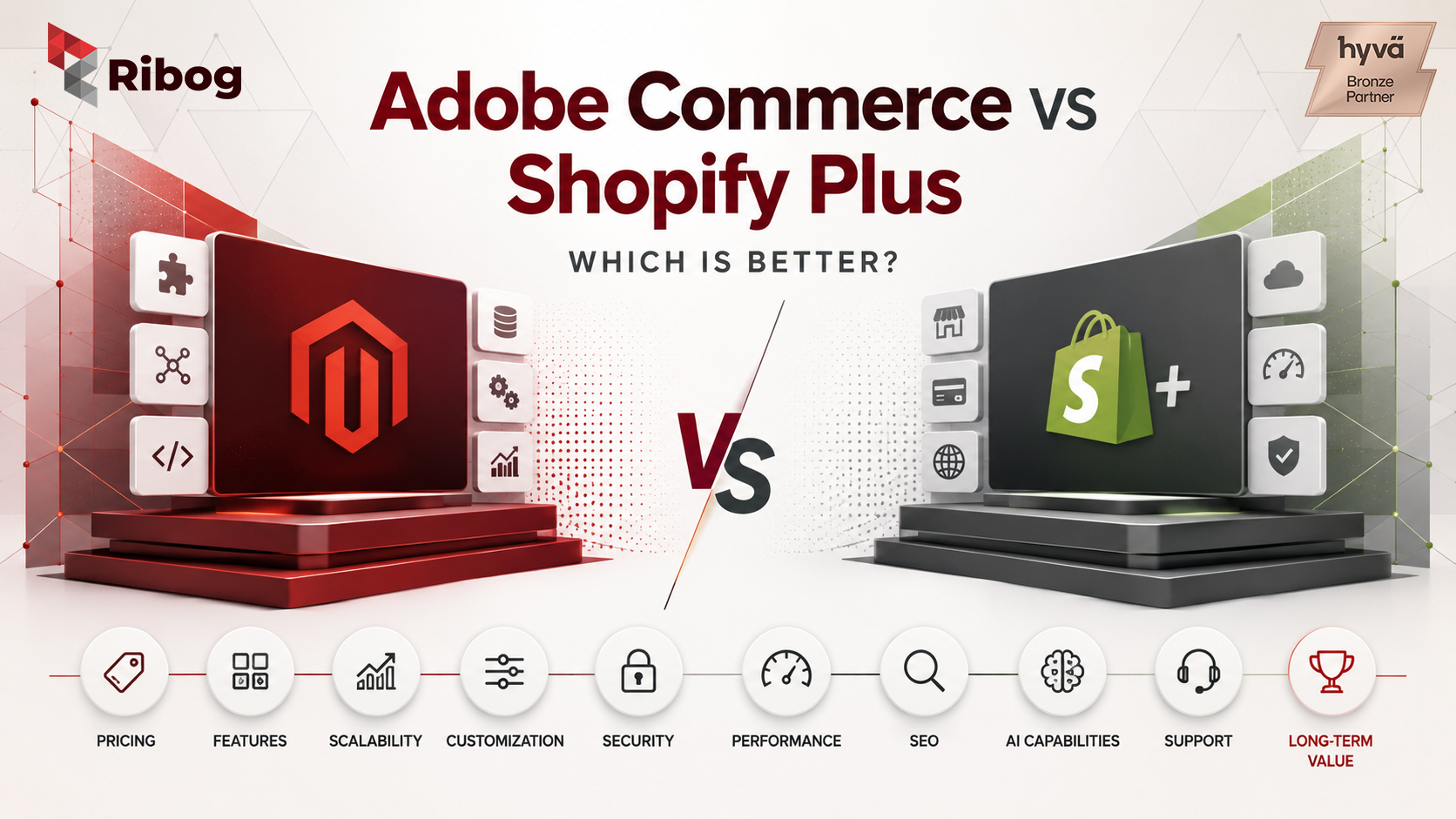
In this comprehensive comparison, we’ll evaluate Adobe Commerce vs Shopify Plus across pricing, features, scalability, customization, security, performance, SEO, AI capabilities, support, and long-term business value to help you determine which platform aligns with your business goals.
Although both platforms serve enterprise merchants, they are built with different philosophies in mind.
Adobe Commerce is an open and highly extensible commerce platform that enables businesses to create tailored shopping experiences without being limited by predefined functionality. Merchants have access to the platform’s source code, making it possible to customize virtually every aspect of the customer journey. According to the Adobe Commerce documentation, businesses can deploy the platform using cloud infrastructure while integrating seamlessly with other Adobe Experience Cloud solutions to create personalized digital experiences across multiple touchpoints.
Shopify Plus takes a different approach by offering a fully managed cloud platform. Shopify manages hosting, platform maintenance, security updates, and infrastructure, reducing operational complexity for merchants. As explained by Shopify Plus, the platform is designed to help fast-growing businesses launch quickly, scale globally, and sell across multiple channels without worrying about server management.
The decision between the two platforms often comes down to one question:
Do you need complete flexibility and control, or do you prioritize operational simplicity and faster time to market?
Both answers are valid—it simply depends on your business model, technical requirements, and long-term growth strategy.
Pricing is one of the first aspects businesses compare, but evaluating only the monthly subscription cost rarely tells the full story. Enterprise eCommerce platforms should be assessed based on their total cost of ownership (TCO), which includes implementation, infrastructure, customization, maintenance, integrations, and ongoing support.
Adobe Commerce Pricing
Unlike many SaaS platforms, Adobe Commerce does not publish a fixed pricing model. Instead, licensing is tailored to each business based on factors such as annual gross merchandise value (GMV), deployment model, business complexity, and required services. Businesses can learn more about Adobe’s licensing approach through the Adobe Commerce pricing page.
Beyond licensing costs, organizations should also consider implementation expenses. A typical Adobe Commerce project may include solution architecture, UI/UX design, custom development, ERP and CRM integrations, third-party extensions, testing, and ongoing maintenance. Depending on the deployment model, businesses may also need to account for hosting and cloud infrastructure costs.
While the upfront investment can be higher than many SaaS platforms, Adobe Commerce provides exceptional flexibility that allows businesses to build highly customized commerce experiences without being constrained by platform limitations. For organizations with complex workflows, multiple storefronts, or sophisticated B2B requirements, this investment often delivers significant long-term value.
Shopify Plus Pricing
Shopify follows a much more transparent pricing model. According to the Shopify Plus pricing page, subscriptions start at USD $2,500 per month on annual plans, although larger enterprise businesses may have customized pricing depending on their transaction volume and business requirements.
The monthly subscription includes managed hosting, automatic platform updates, PCI compliance, security management, unlimited bandwidth, and access to Shopify’s global infrastructure. These bundled services make budgeting more predictable compared to platforms where infrastructure costs are managed separately.
However, businesses should also evaluate the additional expenses associated with premium Shopify apps, custom development, API integrations, theme customization, and ongoing agency support. As operational requirements become more advanced, subscription costs for third-party applications can increase significantly.
For businesses looking to launch quickly with minimal infrastructure management, Shopify Plus offers a straightforward pricing structure. However, companies with highly customized workflows should evaluate whether relying on multiple third-party apps introduces additional complexity and long-term costs.
Which Platform Offers Better Value?
The answer depends less on the initial subscription fee and more on your long-term business objectives.
If your organization values rapid deployment, predictable operational costs, and minimal technical overhead, Shopify Plus can provide excellent value.
On the other hand, if your business requires extensive customization, advanced B2B capabilities, deep ERP integrations, or unique customer experiences, Adobe Commerce often proves to be the better long-term investment despite the higher implementation costs.
Instead of asking which platform is cheaper, businesses should ask which platform can continue supporting their growth five years from now without forcing costly compromises.
Both Adobe Commerce and Shopify Plus deliver enterprise-grade functionality, but the depth and flexibility of their features differ considerably.
Adobe Commerce is built for businesses that require powerful native capabilities without relying heavily on third-party applications. The platform includes advanced catalog management, customer segmentation, personalized promotions, multi-store management, multi-language and multi-currency support, extensive APIs, and sophisticated merchandising tools. For B2B organizations, Adobe Commerce also offers native features such as company accounts, shared catalogs, purchase approvals, requisition lists, and negotiable quotes, making it well suited for manufacturers, wholesalers, and distributors.
Adobe continues to expand its commerce ecosystem through intelligent services available via Adobe Experience League, including AI-powered product recommendations, intelligent search capabilities, and merchandising tools that help merchants improve customer engagement and conversions.
Shopify Plus focuses on providing a streamlined experience with enterprise capabilities that are easy to configure and maintain. The platform includes Shop Pay, Shopify Markets for international selling, Shopify Flow for workflow automation, Shopify Functions for customization, headless commerce support, omnichannel selling, and native B2B functionality for wholesale merchants. Shopify also maintains a large ecosystem of applications that allows businesses to extend platform functionality without extensive development.
One of Shopify Plus’s greatest strengths is its ease of use. Business users can manage products, promotions, content, and orders without requiring deep technical expertise, making it an attractive option for organizations with lean internal teams.
Adobe Commerce, however, offers significantly greater flexibility. Because merchants have full access to the underlying platform, they can build highly customized customer experiences, integrate virtually any third-party system, and develop unique business workflows that would be difficult—or sometimes impossible—to achieve within a SaaS environment.
Ultimately, the choice comes down to business complexity. If your requirements closely align with Shopify’s ecosystem and standardized workflows, Shopify Plus offers an efficient and user-friendly solution. If your business processes are unique, highly customized, or expected to evolve significantly over time, Adobe Commerce provides the flexibility needed to support long-term innovation without being limited by the platform itself.
Every successful eCommerce business reaches a point where growth introduces new challenges. Expanding into international markets, managing multiple storefronts, handling seasonal traffic spikes, or supporting different customer segments requires a platform that can scale without compromising performance or operational efficiency.
Both Adobe Commerce and Shopify Plus are designed to support growing businesses, but they scale in different ways.
Adobe Commerce Scalability
Adobe Commerce is built to accommodate businesses with complex operational requirements. Whether you’re managing multiple brands, operating across different countries, or serving both B2B and B2C customers, the platform provides the flexibility to scale according to your business model rather than forcing you to adapt to predefined workflows.
One of Adobe Commerce’s greatest strengths is its multi-store architecture. Businesses can manage multiple websites, stores, languages, and currencies from a single administrative interface while maintaining unique catalogs, pricing strategies, and customer experiences for each storefront. This makes Adobe Commerce particularly attractive for enterprises operating globally or managing multiple brands.
As your business grows, Adobe Commerce also allows you to scale your infrastructure independently. Since merchants have greater control over hosting and deployment, resources can be optimized to meet increasing traffic demands, integrate additional backend systems, or support complex business processes. Businesses using Adobe Commerce on cloud infrastructure can also leverage Adobe’s cloud services to improve scalability and reliability, as outlined in the Adobe Commerce documentation.
This flexibility makes Adobe Commerce a preferred choice for organizations expecting significant long-term growth or requiring enterprise-level architecture.
Shopify Plus Scalability
Shopify Plus takes a different approach by abstracting infrastructure management away from merchants.
Because Shopify is a fully managed SaaS platform, businesses don’t need to worry about server capacity, database optimization, or handling sudden traffic spikes. Shopify automatically scales its infrastructure behind the scenes, allowing merchants to focus on selling rather than maintaining technical resources.
This simplicity is one of Shopify Plus’s biggest advantages. Whether you’re launching a flash sale, running a global marketing campaign, or experiencing seasonal traffic during events like Black Friday, Shopify manages the underlying infrastructure automatically.
Shopify also supports international expansion through Shopify Markets, enabling businesses to sell across multiple regions while managing localized experiences from a centralized platform. According to Shopify Markets, merchants can localize currencies, languages, pricing, and domains to improve the shopping experience for international customers.
For businesses that prioritize operational simplicity and rapid expansion, Shopify Plus offers a highly scalable environment with minimal technical overhead.
Which Platform Scales Better?
Both platforms can support enterprise-scale businesses, but they serve different types of growth.
If your business requires multiple brands, complex pricing structures, advanced B2B workflows, or extensive backend integrations, Adobe Commerce offers greater architectural flexibility.
If your goal is to expand quickly with minimal infrastructure management, Shopify Plus provides an easier path to scale while reducing operational complexity.
Customization is one of the most significant differences between Adobe Commerce and Shopify Plus.
Modern eCommerce businesses rarely operate with identical workflows. Customer journeys, checkout experiences, pricing models, product configurations, and integrations often need to be tailored to specific business requirements. The level of customization your platform supports can have a direct impact on long-term growth and innovation.
Adobe Commerce Customization
Adobe Commerce is widely recognized for its exceptional flexibility.
Since merchants have access to the platform’s source code, developers can customize virtually every aspect of the storefront and backend. This includes catalog management, checkout flows, customer accounts, business logic, APIs, integrations, promotions, search functionality, and frontend experiences.
Businesses can also adopt a headless commerce architecture using Adobe Commerce APIs, allowing them to build custom storefronts with technologies such as React, Vue, or Hyvä while maintaining Adobe Commerce as the commerce engine.
This level of flexibility enables organizations to create highly personalized shopping experiences, integrate with complex ERP, CRM, PIM, and OMS systems, and automate sophisticated business processes without being restricted by platform limitations.
For companies with unique operational requirements, Adobe Commerce provides the freedom to innovate rather than compromise.
Shopify Plus Customization
Shopify Plus also supports customization, but within the boundaries of its SaaS architecture.
Merchants can customize storefronts using Liquid, Shopify’s templating language, extend functionality through Shopify Functions, automate processes using Shopify Flow, and integrate third-party applications through Shopify’s APIs.
In recent years, Shopify has significantly expanded its customization capabilities, particularly around checkout extensibility and headless commerce. However, merchants still do not have access to the platform’s underlying source code.
As a result, highly specialized business requirements may require workarounds, third-party applications, or adjustments to existing workflows.
For many growing businesses, these limitations are rarely noticeable. However, enterprises with highly customized operations may eventually encounter constraints that require careful evaluation.
Which Platform Offers Greater Flexibility?
For businesses seeking complete ownership over their commerce experience, Adobe Commerce remains one of the most customizable enterprise platforms available.
Shopify Plus excels at simplifying customization while protecting platform stability, making it an excellent option for organizations that prefer standardized workflows with moderate flexibility.
Security is a critical consideration for every enterprise eCommerce platform. Protecting customer data, maintaining PCI compliance, and responding quickly to emerging threats are essential for building customer trust and meeting regulatory requirements.
Both Adobe Commerce and Shopify Plus invest heavily in security, but the responsibility for managing that security differs significantly.
Adobe Commerce Security
Adobe Commerce provides enterprise-grade security capabilities, including role-based access control, two-factor authentication, content security policies, CAPTCHA support, and regular security patches.
Adobe also publishes security updates and best practices through the Adobe Commerce Security Center, helping merchants protect their stores against newly discovered vulnerabilities.
However, because Adobe Commerce offers greater deployment flexibility, merchants are also responsible for ensuring their infrastructure remains secure. This typically involves working with experienced Adobe Commerce partners to apply updates promptly, monitor servers, and follow security best practices.
Organizations that maintain their stores proactively can achieve an exceptionally secure environment while retaining complete control over their infrastructure.
Shopify Plus Security
With Shopify Plus, security management is largely handled by Shopify itself.
The platform automatically manages hosting, infrastructure updates, PCI compliance, SSL certificates, and platform security, significantly reducing the operational burden on merchants.
Because every Shopify Plus store operates within Shopify’s managed ecosystem, businesses don’t need to worry about applying platform patches or maintaining server security.
This approach makes Shopify Plus particularly attractive for organizations that lack dedicated infrastructure teams or want to minimize technical maintenance.
Security Verdict
Neither platform is inherently more secure than the other.
Adobe Commerce offers greater control and flexibility but requires merchants to actively manage security alongside their implementation partners.
Shopify Plus simplifies security by handling most responsibilities internally, allowing businesses to focus on operations rather than infrastructure.
The better choice depends on whether your organization values complete control or prefers a fully managed security model.
Website performance directly impacts user experience, conversion rates, and search engine rankings.
Both Adobe Commerce and Shopify Plus are capable of delivering fast shopping experiences, but performance depends on different factors.
Adobe Commerce offers extensive optimization opportunities. Merchants can fine-tune server infrastructure, implement advanced caching strategies, optimize databases, configure CDNs, and leverage technologies such as Hyvä to significantly improve frontend performance. Because businesses control the underlying architecture, experienced development teams can optimize stores for exceptional speed and Core Web Vitals performance.
Shopify Plus, meanwhile, benefits from its globally managed infrastructure. Merchants automatically receive content delivery, optimized hosting, and platform-level performance improvements without managing servers or infrastructure.
While Shopify’s standardized architecture helps maintain consistent performance across stores, Adobe Commerce provides more flexibility for businesses that require advanced optimization or highly customized storefront experiences.
Ultimately, both platforms can deliver excellent performance. Shopify Plus emphasizes simplicity and consistency, while Adobe Commerce rewards businesses that invest in performance optimization with greater flexibility and control over the customer experience.
Search engine optimization (SEO) remains one of the most cost-effective channels for acquiring customers, especially for businesses with large product catalogs and long-term growth objectives. While both Adobe Commerce and Shopify Plus provide solid SEO foundations, they offer different levels of flexibility.
Adobe Commerce SEO
Adobe Commerce gives merchants extensive control over technical and on-page SEO. Businesses can customize URL structures, metadata, canonical tags, robots.txt, XML sitemaps, redirects, schema markup, and internal linking strategies. Because the platform is highly extensible, developers can implement advanced SEO enhancements tailored to specific business requirements.
For businesses with thousands of products, multiple storefronts, or international SEO strategies, this level of flexibility can be a significant advantage. Adobe Commerce also supports headless implementations, allowing merchants to build high-performance frontends while maintaining strong SEO practices when implemented correctly.
Additionally, merchants can optimize Core Web Vitals by improving frontend performance, implementing advanced caching, and leveraging lightweight frontend technologies such as Hyvä. Faster websites generally contribute to improved user experience and search visibility.
Shopify Plus SEO
Shopify Plus includes many essential SEO features out of the box, including editable title tags, meta descriptions, XML sitemaps, canonical URLs, redirects, SSL certificates, and mobile-friendly themes. For many businesses, these built-in capabilities are sufficient to build a strong organic search presence.
However, Shopify’s hosted architecture means certain technical aspects are predefined. For example, URL structures for products and collections follow Shopify’s conventions, limiting the level of customization available compared to Adobe Commerce.
That said, Shopify continues to improve its SEO capabilities, and businesses can achieve excellent search performance when following best practices published in the Shopify SEO documentation.
Which Platform Is Better for SEO?
If your SEO strategy relies on extensive technical customization, international targeting, complex site structures, or large enterprise catalogs, Adobe Commerce provides greater flexibility.
For businesses looking for a platform that handles the fundamentals well with minimal technical effort, Shopify Plus offers a strong SEO foundation that supports sustainable organic growth.
Artificial intelligence is becoming an essential part of modern commerce, helping businesses deliver personalized shopping experiences, automate repetitive tasks, and make data-driven decisions.
Adobe Commerce AI
Adobe has invested heavily in AI through Adobe Sensei and its broader Adobe Experience Cloud ecosystem. Adobe Commerce merchants can benefit from intelligent product recommendations, AI-powered search, personalized merchandising, and content optimization services designed to improve customer engagement and conversion rates.
Adobe is also expanding its AI capabilities through Adobe Experience Platform, enabling businesses to unify customer data and deliver more personalized experiences across multiple digital channels. Businesses can learn more through Adobe Sensei.
These capabilities make Adobe Commerce particularly attractive for enterprises focused on delivering highly personalized customer journeys at scale.
Shopify Plus AI
Shopify has also accelerated its investment in artificial intelligence with the introduction of Shopify Magic and Sidekick. Shopify Magic assists merchants with tasks such as generating product descriptions, email content, and customer communication, while Sidekick acts as an AI-powered commerce assistant to help merchants manage their stores more efficiently.
As outlined by Shopify Magic, these AI-powered tools are designed to improve productivity while simplifying everyday business operations.
Shopify’s AI strategy focuses on making advanced capabilities accessible to merchants without requiring additional technical expertise.
AI Verdict
Both platforms are investing significantly in artificial intelligence, but their priorities differ.
Adobe Commerce focuses on enterprise-grade personalization, customer intelligence, and advanced merchandising.
Shopify Plus emphasizes merchant productivity, operational efficiency, and simplifying day-to-day commerce management through AI-assisted workflows.
The better choice depends on whether your business prioritizes customer experience optimization or operational simplicity.
Reliable support becomes increasingly important as businesses grow and their commerce operations become more complex.
Adobe Commerce provides enterprise support alongside a global ecosystem of certified implementation partners, solution specialists, and developers. Businesses also have access to extensive technical resources through Adobe Experience League, which includes product documentation, tutorials, release notes, and implementation best practices.
Many enterprise merchants also choose to work with experienced Adobe Commerce agencies for ongoing development, maintenance, security updates, and performance optimization.
Shopify Plus includes dedicated merchant support and access to customer success resources designed to help businesses maximize platform adoption. Shopify also maintains comprehensive documentation through the Shopify Help Center, making it easy for merchants to find guidance on everything from store configuration to international selling.
Both platforms offer strong support ecosystems, although Adobe Commerce typically involves closer collaboration with implementation partners due to its greater flexibility and customization.
There is no universal winner because Adobe Commerce and Shopify Plus are built for different types of businesses.
Adobe Commerce is the stronger choice for organizations that require complete control over their commerce platform, advanced B2B capabilities, complex integrations, multi-store management, and highly customized customer experiences. Businesses with dedicated technical teams or trusted implementation partners often benefit from the platform’s flexibility and long-term scalability.
Shopify Plus is an excellent option for businesses that value speed, simplicity, and predictable operations. Its fully managed infrastructure allows merchants to launch quickly, reduce technical overhead, and focus on growing their business rather than maintaining the platform.
If your business expects to evolve significantly over the coming years, requires extensive customization, or operates with complex workflows, Adobe Commerce provides greater freedom to innovate without being constrained by platform limitations.
If your primary objective is to accelerate growth while minimizing operational complexity, Shopify Plus delivers a polished and user-friendly enterprise commerce experience.
Ultimately, the right platform isn’t the one with the longest feature list—it’s the one that aligns with your business strategy, operational requirements, and future growth plans.
Is Adobe Commerce better than Shopify Plus?
It depends on your business requirements. Adobe Commerce offers greater customization, flexibility, and enterprise capabilities, while Shopify Plus focuses on ease of use, faster implementation, and simplified platform management.
Which platform is better for B2B commerce?
Adobe Commerce has a clear advantage for complex B2B businesses because it includes native capabilities such as company accounts, shared catalogs, requisition lists, purchase approvals, and negotiable quotes. Shopify Plus also supports B2B commerce but is generally better suited to businesses with less complex wholesale workflows.
Which platform is more scalable?
Both platforms are highly scalable. Adobe Commerce provides greater architectural flexibility for enterprises with unique operational requirements, while Shopify Plus automatically scales its managed infrastructure as your business grows.
Which platform is better for SEO?
Adobe Commerce provides more control over technical SEO and customization, making it a strong choice for businesses with advanced SEO strategies. Shopify Plus offers excellent built-in SEO features that are sufficient for many growing brands.
Which platform is easier to maintain?
Shopify Plus is easier to maintain because Shopify manages hosting, security updates, and infrastructure. Adobe Commerce offers more flexibility but typically requires ongoing technical support and maintenance.
Both Adobe Commerce and Shopify Plus are exceptional enterprise eCommerce platforms, but they solve different business challenges.
If your priority is launching quickly with minimal infrastructure management and a streamlined user experience, Shopify Plus is a compelling solution.
However, if your business requires advanced customization, enterprise-grade B2B functionality, seamless integration with existing business systems, and complete ownership of your commerce experience, Adobe Commerce remains one of the most powerful and future-ready platforms available.
Rather than focusing solely on implementation costs or feature comparisons, businesses should evaluate where they expect to be in the next five to ten years. Choosing a platform that aligns with your long-term strategy can reduce future migration costs, support innovation, and provide a stronger foundation for sustainable growth.
Whether you’re planning a migration from Shopify Plus to Adobe Commerce, evaluating enterprise commerce platforms, or looking to modernize your existing Adobe Commerce store, the right implementation strategy can make all the difference.
At Ribog Digital, we specialize in Adobe Commerce development, Hyvä implementation, performance optimization, platform migrations, and long-term support for growing eCommerce businesses. Our team works closely with merchants to understand their business goals and recommend solutions that deliver measurable results.
Get in touch with our experts to discuss your project and discover which platform is the right fit for your business.