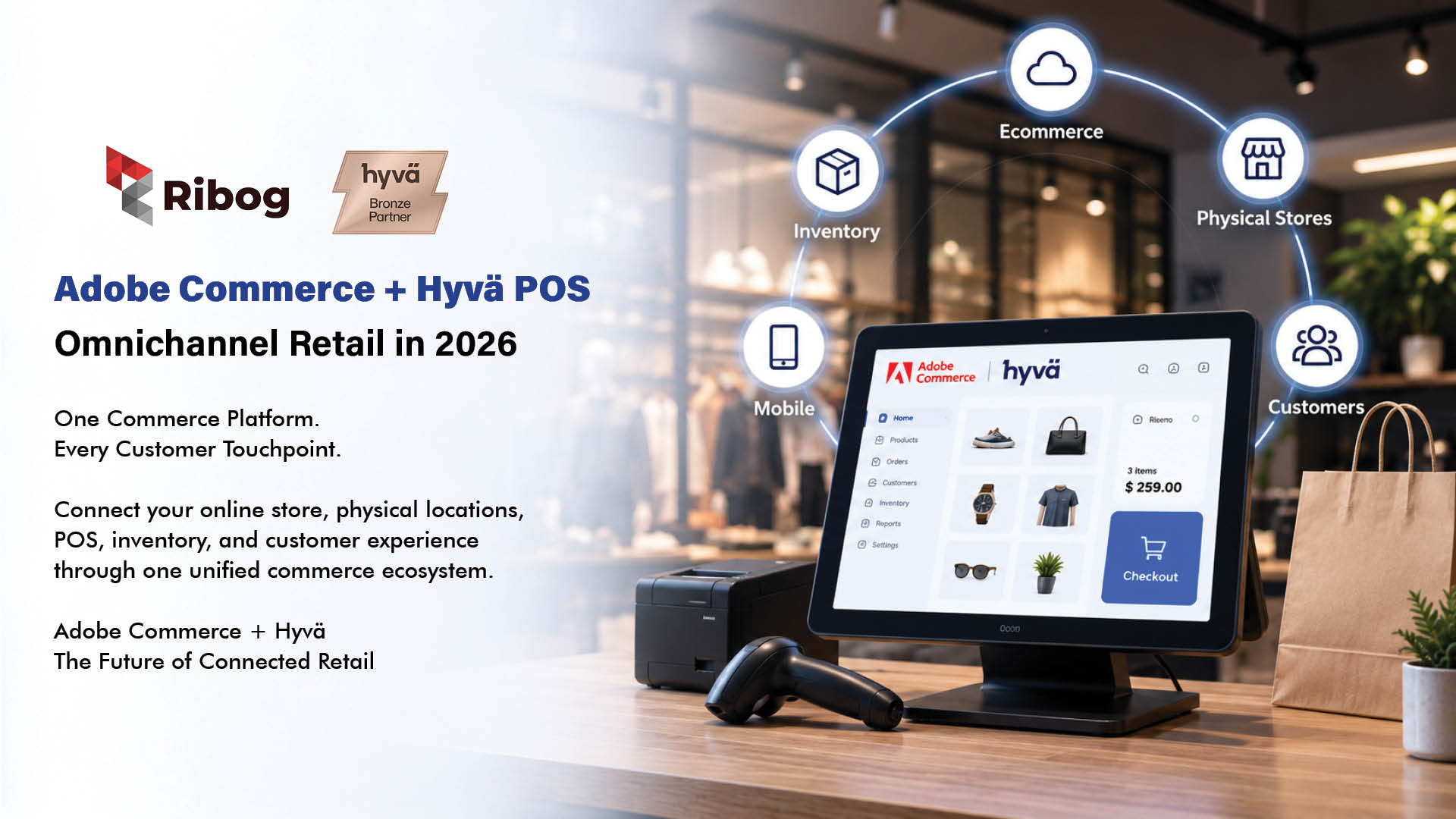
For many retailers, having an eCommerce website and physical stores is no longer enough. Customers expect to move between online and offline shopping without feeling that they are interacting with two completely separate businesses.
A customer might discover a product online, visit a physical store to see it, purchase it at the counter, return it later through another channel, or expect store staff to understand their customer profile and available products. Behind the scenes, delivering that experience requires much more than a fast storefront. It requires products, customers, orders, pricing and inventory to work together.
This is where the combination of Adobe Commerce and Hyvä POS becomes particularly interesting.
Adobe Commerce already provides inventory management capabilities designed for businesses operating across multiple physical and virtual locations. Its Inventory Management system supports networks involving warehouses, stores, pickup locations, distribution centers and other fulfillment locations.
Hyvä POS takes the concept further by connecting a point-of-sale experience directly to Magento. According to the current official Hyvä POS documentation, Hyvä POS is a native iPad point-of-sale application that communicates directly with a Magento store using Magento’s REST API. The documentation states that products, customers, orders, stock and promotions come from Magento, while in-store sales are recorded as Magento orders alongside online sales.
For retailers already using Adobe Commerce with a Hyvä-based storefront, this creates an opportunity to think beyond an “eCommerce website” and toward a unified omnichannel retail platform.
Hyvä POS is designed to provide a point-of-sale interface connected directly to Magento.
The important distinction is that it is not positioned as a completely separate commerce database that must constantly synchronize with Magento. The Hyvä POS architecture documentation describes the iPad application as communicating directly with Magento through the standard REST API, with Magento remaining the single source of truth for products, customers, orders, prices, promotions and stock.
That changes the traditional model.
Instead of:
eCommerce Platform + Separate POS + Synchronization Layer
the architecture can move toward:
Adobe Commerce → Online Store + Physical Retail
The goal is not simply to provide store employees with a checkout screen. The larger opportunity is to connect online and physical commerce around the same underlying commerce platform.
A Magento implementation may initially have one straightforward objective: sell products online.
As the business grows, the requirements become more complex.
A retailer may add physical stores, warehouses, regional fulfillment centers, pickup locations, multiple websites, or different customer groups. Each new channel can introduce additional inventory and operational complexity.
Adobe Commerce’s Inventory Management documentation explains that Commerce can manage inventory across one or more websites and physical or virtual product locations, including warehouses, stores, pickup locations, drop shippers and other fulfillment locations.
This means Adobe Commerce can already provide an important foundation for multi-location commerce.
Hyvä POS adds another layer by bringing physical point-of-sale activity into that Magento environment.
The result is a model in which the same commerce platform can support both digital transactions and physical store transactions.
One of the most important changes is architectural rather than visual.
When a POS operates as a completely separate platform, retailers often need integrations to move information between systems.
For example:
Online Store → Integration → POS
POS → Integration → Inventory
POS → Integration → Customer Database
Inventory → Integration → eCommerce Website
Every connection introduces another system that must be monitored, maintained and synchronized.
The current Hyvä POS integration model is different. Hyvä states that the POS has no separate POS database or middleware layer and instead communicates directly with Magento using standard REST APIs.
For retailers, that can change the role of Adobe Commerce.
It is no longer simply the platform powering the website.
It can become the central commerce layer connecting digital and physical retail operations.
A unified product catalog is one of the most obvious advantages of a centralized commerce architecture.
Consider a retailer selling 2,000 products online and operating five physical stores.
With separate commerce and POS systems, product information may need to be maintained or synchronized across multiple platforms.
With Hyvä POS connected to Magento, the POS works against the Magento catalog. Hyvä’s documentation explains that catalog information is accessed through Magento’s standard API and that product information can also be cached on the device for speed.
This means the same commerce environment can support product information used by both online customers and store employees.
That can be particularly valuable for businesses with:
The objective is not simply reducing data entry. It is creating a more consistent product experience across channels.
The real foundation of omnichannel retail is inventory.
A beautiful POS interface does not solve the problem of selling an item that is unavailable.
Adobe Commerce’s official Stocks and Sources documentation explains that a source represents a physical location where inventory is managed, while a stock represents aggregated inventory available to sales channels.
For a retailer, this could mean:
Store A: 8 units
Store B: 3 units
Central Warehouse: 25 units
Instead of treating inventory as one simple number, the business can manage quantities according to individual locations.
Adobe Commerce also uses reservations and salable quantities to help manage inventory throughout the shopping and checkout process. Reservations account for inventory during the order lifecycle, while salable quantity represents the amount available for purchase through a stock.
This matters because omnichannel commerce ultimately depends on answering a simple customer question:
“Can I get this product, and where can I get it?”
The answer depends on accurate inventory.
When a retailer expands from one location to several, Magento’s inventory architecture becomes increasingly important.
Adobe Commerce allows merchants to create sources for locations such as warehouses, brick-and-mortar stores, distribution centers and drop shippers.
For example, a retailer could configure:
Source 1 — Ahmedabad Store
Source 2 — Mumbai Store
Source 3 — Delhi Store
Source 4 — Central Warehouse
Each location can have its own inventory quantities.
Adobe Commerce can then use stocks to associate sources with sales channels and establish source priorities for fulfillment.
This is where the combination of Adobe Commerce and POS becomes more powerful than simply adding a payment terminal to a website.
The physical store becomes another component of the retailer’s broader commerce and inventory architecture.
Another major change is the relationship between online and offline orders.
In a fragmented architecture, online orders and store orders may exist in completely different systems.
That can make reporting, customer service, returns and downstream integrations more complicated.
Hyvä’s current POS documentation states that an in-store sale becomes a Magento order alongside online orders.
This creates a more unified order environment.
Instead of asking:
“Which system contains this transaction?”
the organization can work toward:
“Which Magento order represents this transaction?”
That can simplify how developers, customer service teams and integration systems interact with commerce data.
Hyvä’s technical documentation also explains that the POS uses Magento web APIs and that the resulting orders are ordinary Magento data that can be observed and extended using standard Magento development approaches.
Omnichannel commerce is not only about products and inventory.
Customers are another important part of the equation.
A customer might browse products online and purchase them in a physical store. Another customer might purchase in a store and later return to the website.
When customer information is maintained centrally in Magento, businesses can build experiences around a shared customer record instead of treating online and offline customers as completely separate audiences.
Hyvä’s official POS documentation identifies customers as one of the core Magento data areas used by the POS.
Depending on the Adobe Commerce configuration and supporting integrations, this architecture can support experiences involving:
The exact experience depends on the retailer’s requirements, configuration and integrations, but the underlying principle remains the same: online and physical retail can operate around a common commerce platform.
Retail businesses frequently struggle with pricing consistency.
An online store may have one promotion while a physical store uses another configuration.
A centralized commerce platform can reduce some of that fragmentation.
The current Hyvä POS feature documentation describes POS support for pricing and discounts, with additional capabilities available through the PRO offering.
This becomes particularly interesting for retailers operating different customer segments.
A business may have:
Centralizing commerce rules can help reduce inconsistencies between channels, although the final implementation should always be designed around the merchant’s actual pricing and promotion requirements.
It is important to distinguish the different products within the Hyvä ecosystem.
Hyvä Theme focuses on the Magento storefront.
Hyvä Checkout focuses on the checkout experience.
Hyvä POS focuses on physical point-of-sale operations.
These solve different problems, but they can exist within the same Magento ecosystem.
The official Hyvä documentation covers the broader Hyvä ecosystem, including its frontend, checkout and commerce products.
For a retailer, this changes the conversation from:
“Should we use Hyvä for our Magento website?”
to:
“How should we modernize our overall Magento commerce experience?”
That is a much more strategic question.
A retailer with one physical store has different requirements from a retailer operating ten stores with multiple registers.
The current Hyvä POS PRO documentation describes functionality for centrally managing multiple locations, terminals and staff.
Hyvä’s documentation also describes POS locations as physical stores that can have their own configuration and staff.
This creates an important distinction between a simple POS deployment and a broader retail architecture.
A single-register deployment may be relatively straightforward.
A multi-store deployment requires planning around:
The technology can provide the foundation, but the implementation still needs to reflect how the retailer actually operates.
Returns are another important part of omnichannel commerce.
Customers increasingly expect flexibility in how they purchase and return products.
For example:
Buy online → Return in store
or:
Buy in store → Continue shopping online
Whether a retailer can support these workflows depends on its configuration, payment infrastructure, return policies and integrations.
The current Hyvä POS documentation includes functionality around returns and RMA within its broader POS capabilities.
This illustrates an important point:
A modern POS should not be viewed simply as a payment terminal.
It becomes another operational interface to the commerce platform.
Adobe Commerce already provides the foundation required for many multi-location inventory scenarios.
Its Inventory Management system supports sources, stocks, source selection, reservations, inventory quantities and fulfillment processes across multiple locations.
Adobe Commerce can support inventory networks containing stores, warehouses, distribution centers and other fulfillment locations.
Its Source Selection Algorithm can also recommend fulfillment sources based on configured priorities and inventory availability.
This is important because adding physical retail should not necessarily mean creating an entirely separate inventory architecture.
Instead, stores can become another component of the retailer’s broader inventory network.
A simplified architecture could look like this:
Customers
↓
Online Store — Hyvä Theme
↓
Adobe Commerce
↓
Products | Customers | Orders | Pricing | Promotions | Inventory
↓
Hyvä POS
↓
Physical Stores and Registers
At the inventory level, Adobe Commerce can connect:
Store A + Store B + Store C + Warehouse
into a broader inventory model.
The exact implementation will vary according to the retailer’s requirements, but the principle remains:
Magento becomes the central commerce layer instead of simply being the online storefront backend.
Moving toward Adobe Commerce + Hyvä POS can change several areas of the business.
The retailer can potentially reduce the number of disconnected systems involved in product, order and inventory management.
Physical stores can participate in a multi-source inventory model alongside warehouses and other fulfillment locations.
Online and in-store transactions can be represented within Magento rather than existing entirely separately.
The business can design experiences that connect digital and physical interactions.
Store staff, inventory teams, eCommerce teams and developers can work around a shared commerce platform.
The integration architecture can become more centralized, although systems such as ERP, accounting, payment terminals, logistics, CRM and specialized retail applications may still be required.
No.
A retailer selling exclusively online does not automatically need a POS.
Hyvä POS becomes more interesting when a business has a meaningful physical retail operation and wants its stores and eCommerce business to work together.
It may be particularly relevant for:
The right architecture depends on the business.
A company with one small physical store may have very different requirements from a national retailer with hundreds of locations.
This is an important consideration when evaluating the technology in 2026.
According to the current official Hyvä POS documentation, Hyvä POS is currently in closed beta/pilot phase and is not yet generally available. Hyvä states that the App Store release will follow the pilot and that features and configuration may change before general release.
Therefore, merchants evaluating the technology should verify current availability, feature coverage, hardware requirements, payment integrations and roadmap directly with Hyvä before planning a production rollout.
The architectural direction, however, is significant: connecting a POS directly to Magento allows the physical store to become another interface to the same commerce platform.
For years, Magento projects were primarily discussed in terms of websites, storefronts, checkout and online sales.
Modern commerce architecture is broader.
An Adobe Commerce implementation can sit at the center of:
eCommerce
Physical retail
Inventory
Customer management
Order management
B2B commerce
ERP integrations
Warehouse operations
Fulfillment
Payments
The emergence of POS capabilities around the Magento ecosystem makes this shift even more visible.
For merchants, the question is no longer simply:
“How can we make our Magento website faster?”
It increasingly becomes:
“How can we use our commerce platform to connect every customer and retail touchpoint?”
That is the real promise of omnichannel commerce.
Adobe Commerce already provides important building blocks for multi-location commerce through its catalog, customer, order and Inventory Management capabilities.
Hyvä POS adds another layer by bringing Magento into the physical point-of-sale environment. Its current architecture connects the POS directly to Magento, with the platform remaining the source for products, customers, orders, pricing, promotions and stock.
For retailers operating both online and physical stores, this creates an opportunity to move away from disconnected commerce systems and toward a more unified architecture.
However, POS should not be treated as a standalone feature that can simply be installed and switched on. Successful omnichannel commerce requires careful planning around inventory sources, stock management, customer accounts, payments, returns, fulfillment, integrations and store operations.
For businesses already investing in Adobe Commerce and Hyvä, the bigger opportunity is to think beyond the storefront.
The next generation of Magento commerce is not just about selling online. It is about connecting the entire retail operation.
At Ribog Digital, we help businesses build and modernize Magento and Adobe Commerce solutions with a focus on performance, scalable architecture, integrations and Hyvä-based commerce experiences. If your business is evaluating a move from a standalone eCommerce store toward an omnichannel retail architecture, the right starting point is an assessment of your current catalog, inventory, integrations and store operations.
Hyvä POS is a point-of-sale solution designed to connect physical retail operations directly with Magento and Adobe Commerce. It allows retailers to manage in-store sales through a POS interface while using Magento as the central commerce platform for products, customers, orders, pricing and inventory.
Yes. Hyvä POS is designed to connect directly with Magento, including Adobe Commerce implementations. Its architecture uses Magento APIs to access commerce data and create orders, allowing physical-store transactions to become part of the broader Magento commerce environment.
A traditional standalone POS typically operates as a separate system and requires integrations to synchronize products, customers, inventory and orders with the eCommerce platform. A Magento-connected POS can instead use Magento as the central commerce platform, reducing the need to maintain completely separate commerce data environments.
No. Hyvä POS is not a replacement for Adobe Commerce. Instead, it extends the commerce platform into physical retail by providing a point-of-sale interface that communicates with Magento.
Adobe Commerce can remain responsible for the core catalog, customers, orders, pricing and inventory, while the POS provides the interface used by store employees.
Yes. Adobe Commerce Inventory Management supports multiple inventory sources, which can represent locations such as physical stores, warehouses and distribution centers. This allows retailers to build a multi-location inventory structure rather than maintaining one undifferentiated stock quantity.
With a Magento-connected POS such as Hyvä POS, in-store transactions can be created as Magento orders alongside online transactions. This can provide retailers with a more centralized order environment and make it easier to connect orders with customers, inventory and other commerce processes.
Hyvä POS is designed with multi-location retail scenarios in mind. Its current documentation describes functionality for managing multiple locations, terminals and staff through its PRO capabilities. The exact configuration depends on the retailer’s requirements and the current product availability.
Yes, this is one of the key use cases for a Magento-connected POS. Retailers can potentially connect their online and physical operations around the same commerce platform, helping create a more consistent experience for products, customers, inventory and orders.
No. Businesses that operate exclusively online generally have no need for a physical POS. Hyvä POS is more relevant to retailers that operate physical stores, showrooms, pop-up locations or other offline sales environments and want those operations connected to Magento.
Hyvä’s current documentation indicates that Hyvä POS is in a closed beta/pilot phase. Availability, functionality and configuration may change as the product progresses toward wider release. Businesses considering implementation should verify the current availability and requirements directly with Hyvä.
The answer depends on the specific systems and implementation architecture. Because Magento remains the central commerce platform, existing Magento APIs, extensions and integration architecture can be used as part of the overall solution. Additional development may be required for ERP, CRM, WMS, accounting, payment or other specialized systems.
No. Hyvä Theme is a frontend solution for Magento storefronts, while Hyvä POS is designed for point-of-sale operations. Hyvä Checkout is another separate product focused on improving the Magento checkout experience. They can form part of a broader Hyvä-based commerce ecosystem but solve different problems.
Moving from a conventional eCommerce setup toward omnichannel commerce requires more than installing a POS system. The underlying Magento architecture needs to be capable of handling products, customers, inventory, orders, integrations and multiple sales channels.
This is where Ribog Digital can help.
Before introducing POS, Ribog can assess your existing Magento or Adobe Commerce implementation to identify architectural limitations, integration dependencies and opportunities for improvement.
The assessment can cover your catalog structure, inventory configuration, customer data, order workflows, third-party extensions, APIs and existing integrations.
This provides a clearer picture of what needs to change before connecting physical retail operations.
If your online store is already running Magento but uses an older frontend, Ribog can help evaluate a migration to the Hyvä frontend ecosystem.
The goal is to create a modern storefront while ensuring that the frontend works effectively with your existing Adobe Commerce functionality and integrations.
For retailers operating multiple stores and warehouses, inventory architecture becomes critical.
Ribog can help plan and implement Magento inventory structures around different physical locations, warehouses and fulfillment requirements, helping businesses establish a more scalable foundation for omnichannel commerce.
A POS implementation should begin with architecture rather than configuration.
Ribog can help evaluate how Hyvä POS could fit into your existing Adobe Commerce environment, including catalog data, customer accounts, inventory, orders, pricing, promotions and third-party integrations.
This can help identify potential compatibility and implementation requirements before development begins.
Most established retailers do not operate Magento in isolation.
Their commerce ecosystem may include an ERP, CRM, warehouse management system, PIM, accounting platform, shipping provider, payment gateway or other business applications.
Ribog can help design Magento integration workflows so that the commerce platform can communicate effectively with the systems that support your wider retail operation.
Every retailer has different requirements.
You may need custom functionality for store-specific pricing, inventory workflows, customer accounts, order processing, fulfillment, reporting or integrations.
Ribog can provide Magento and Adobe Commerce development to extend the platform around your specific business requirements rather than forcing your processes into a generic implementation.
Adding Hyvä to an existing Magento store can involve more than replacing the visual frontend.
Extensions, custom modules, checkout functionality and third-party integrations may need to be evaluated for compatibility.
Ribog can help review the existing Magento implementation and develop Hyvä-compatible solutions where required.
Omnichannel commerce does not mean the online experience should be overlooked.
Your digital storefront still needs to provide a fast and frictionless experience across desktop and mobile devices.
Ribog can help optimize Magento and Hyvä storefronts with a focus on frontend performance, Core Web Vitals, user experience, checkout performance and scalable development practices.
Omnichannel commerce is an ongoing technology project rather than a one-time installation.
Magento and Adobe Commerce stores require security updates, compatibility checks, extension maintenance, performance monitoring and continuous improvements.
Ribog can support businesses after implementation with ongoing Magento, Adobe Commerce and Hyvä development and maintenance.
The move from eCommerce to omnichannel commerce represents a fundamental change in how retailers think about their technology stack.
Instead of maintaining separate systems for online shopping, physical stores, inventory and customer information, businesses can build toward a more connected commerce architecture.
Adobe Commerce can provide the central commerce foundation.
Hyvä can provide the modern digital storefront experience.
Hyvä Checkout can streamline the online purchasing journey.
Hyvä POS can extend the commerce experience into physical retail.
Integrations can connect the commerce platform with ERP, CRM, WMS, PIM and other business systems.
Ribog Digital can help bring these components together into a commerce architecture designed around your business requirements.
Whether you are planning a new Adobe Commerce implementation, migrating an existing Magento store to Hyvä, introducing multi-location inventory or evaluating how POS can connect your physical and digital retail channels, the first step is understanding your current architecture and identifying the right path forward.
Looking to turn your Magento store into a more connected omnichannel commerce platform? Ribog Digital can help you plan, develop and optimize your Adobe Commerce and Hyvä ecosystem.