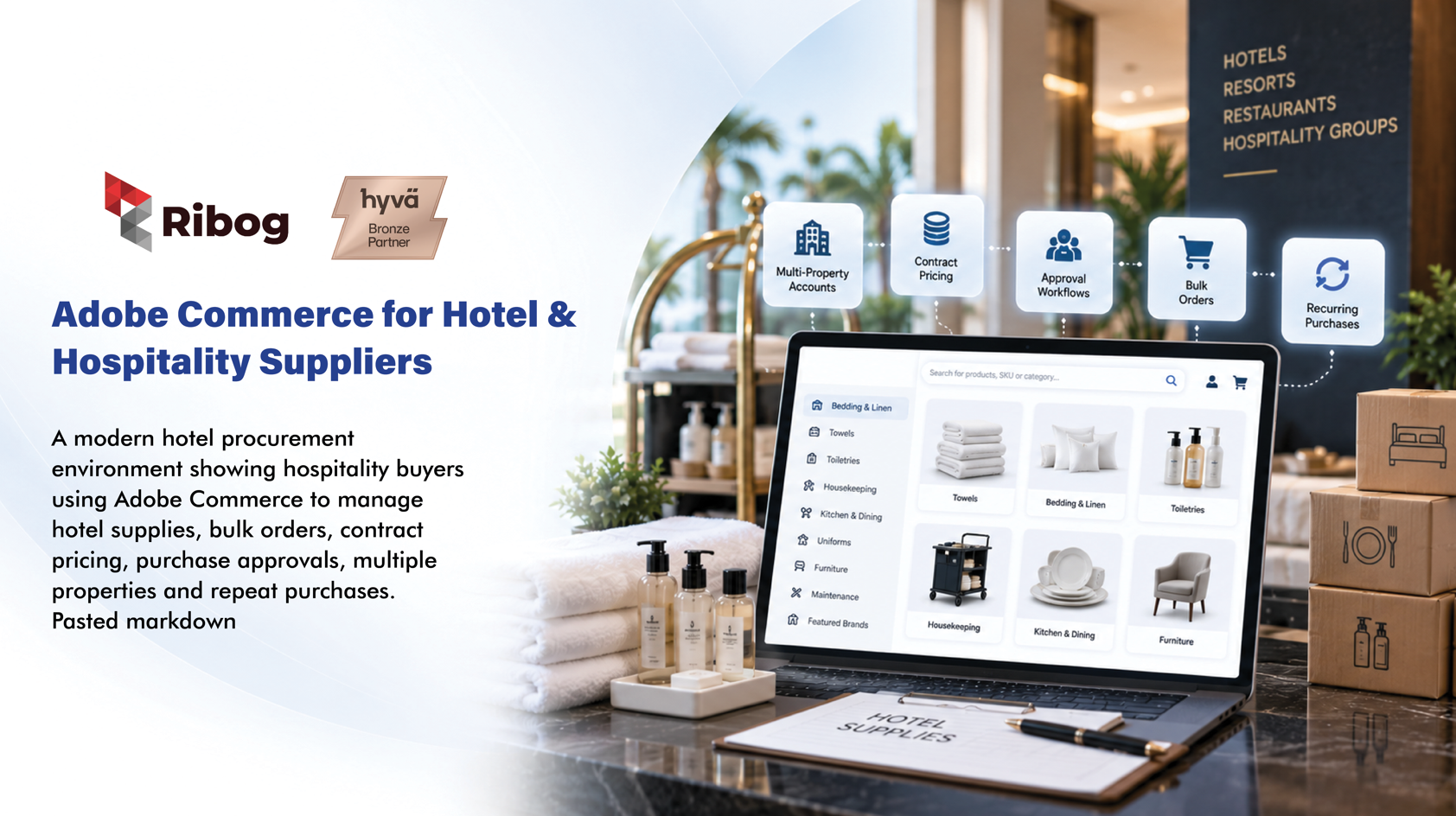
Hotels and hospitality groups rarely purchase products like ordinary online shoppers. A single property may need hundreds of towels, linens, toiletries, housekeeping supplies, kitchen equipment, uniforms, furniture, maintenance products and other operational items—often on recurring schedules and under negotiated business terms.
For hotel suppliers, this creates a very different eCommerce challenge.
A hospitality buyer may need to purchase on behalf of a hotel, resort, restaurant group or property management company while managing multiple locations, different users, negotiated pricing, purchase approvals, bulk quantities and recurring orders.
This is where Adobe Commerce for hotel suppliers can provide a structured digital purchasing experience.
Adobe Commerce includes B2B capabilities such as company accounts, shared catalogs, custom pricing, purchase orders, approval workflows, quick orders and requisition lists. These features are designed for businesses that sell to organizations with multiple buyers and purchasing permissions.
Hospitality procurement is often more complex than standard B2C shopping.
Consider a hotel group purchasing supplies for 15 properties. The procurement team may need:
A conventional online store may allow a customer to add products to a cart and check out. But a hospitality supplier needs to support the business process surrounding the order, not just the transaction itself.
Adobe Commerce B2B provides company accounts that can represent organizations and support multiple users, roles and purchasing permissions.
Adobe Commerce B2B — Company Accounts
A hotel group may operate several properties under the same corporate organization.
For example:
Global Hospitality Group
Instead of treating every buyer as an independent customer, Adobe Commerce company accounts can organize buyers under a business account.
Adobe states that company accounts can support multiple subaccounts, roles and permissions, allowing the purchasing structure of an organization to be represented within the commerce platform.
This can be particularly useful when a hotel group’s procurement department, property managers and individual purchasing teams all need different levels of access.
A supplier can therefore build a digital purchasing environment that reflects the customer’s organizational structure rather than simply creating hundreds of unrelated customer accounts.
Hotel suppliers often work with negotiated commercial agreements.
A five-star hotel group ordering 5,000 units of a product may not receive the same pricing as a small independent property ordering 50 units.
Adobe Commerce Shared Catalogs allow merchants to create custom catalogs with pricing that is available to specific company accounts.
For example, a supplier could configure:
| Customer | Catalog | Pricing |
|---|---|---|
| Hotel Group A | Premium Hospitality Catalog | Contract pricing |
| Hotel Group B | Standard Hotel Catalog | Agreed wholesale pricing |
| Independent Hotels | Hospitality Wholesale | Tiered pricing |
| Restaurants | Foodservice Catalog | Restaurant pricing |
This allows the supplier to maintain different commercial relationships without necessarily creating a completely separate storefront for every customer.
Adobe’s documentation explains that custom shared catalogs can contain custom pricing and can be assigned to specific companies.
Adobe Commerce — Shared Catalogs
Hospitality buyers don’t always purchase one or two units.
A procurement manager might need:
Searching for each SKU individually can make the ordering process unnecessarily slow.
Adobe Commerce includes Quick Order, which is designed to reduce the ordering process for customers who already know the product name or SKU they want.
For hotel suppliers with large product catalogs, this can make a significant difference to the purchasing experience.
Instead of browsing through categories repeatedly, an experienced buyer can work directly with known SKUs and quantities.
The more frequently a customer purchases the same products, the less useful extensive product discovery becomes.
A procurement team often already knows:
what it needs → which SKU it uses → how many units it needs.
The eCommerce platform should therefore make repeat purchasing efficient.
Purchase orders are particularly relevant to hospitality procurement.
A hotel employee may be authorized to create an order, while the property’s procurement manager or corporate purchasing team must approve it before the purchase is finalized.
Adobe Commerce B2B supports purchase order workflows and approval rules. Depending on company roles and order values, different approval requirements can be applied.
For example:
Housekeeping Manager
↓
Creates PO for $2,000
Property Procurement Manager
↓
Reviews order
Finance / Corporate Procurement
↓
Approves higher-value purchase
This type of workflow can help suppliers support the purchasing policies already used by their hospitality customers.
Adobe’s documentation provides examples where approval rules can be based on order value and user roles.
Adobe Commerce — Purchase Orders and Approvals
Hospitality businesses purchase many products repeatedly.
A hotel may reorder:
Instead of rebuilding the same order from scratch, buyers can benefit from tools designed for repeat purchasing.
Adobe Commerce provides Requisition Lists, which allow customers to maintain lists of frequently purchased products and add those products to the shopping cart when required.
A hotel could maintain lists such as:
Housekeeping Essentials
Guest Room Supplies
Kitchen Consumables
Maintenance Supplies
Monthly Property Reorder
This transforms the storefront from a simple product catalog into a more practical purchasing workspace.
Multi-property purchasing introduces another challenge: where should an order go?
A hotel group may have properties in several cities, each with its own receiving address and purchasing requirements.
The commerce architecture therefore needs to distinguish between:
Adobe Commerce company structures can represent divisions, subdivisions and users within an organization. Adobe specifically describes company hierarchies as a way to organize companies with multiple divisions and subdivisions.
This provides a foundation for designing a purchasing experience around the structure of a hospitality organization.
Not every hospitality employee should have identical purchasing authority.
For example:
| User | Possible Role |
|---|---|
| Corporate Procurement | Manage purchasing across properties |
| Property Manager | Approve property-level orders |
| Purchasing Executive | Create purchase orders |
| Department Manager | Request products |
| Finance Team | Review purchasing and payment information |
Adobe Commerce company accounts support different users, roles and permissions within a company structure.
This is particularly relevant for hospitality suppliers serving larger hotel groups where purchasing decisions are distributed across corporate and property-level teams.
A hotel supplier may serve multiple segments at the same time.
For example:
Hotels
Restaurants
Resorts
Corporate Hospitality Groups
Adobe Commerce Shared Catalogs allow merchants to control which products and custom prices are available to specific companies.
That means the supplier can create a more relevant purchasing experience instead of presenting every customer with the entire product database.
For established hospitality suppliers, the website is rarely the only business system.
The broader technology environment may include:
The goal should not simply be to put a catalog online.
Instead, the Adobe Commerce implementation should be designed around the supplier’s existing operational architecture.
For example:
Customer places order
→ Adobe Commerce
→ ERP / order management
→ Inventory confirmation
→ Warehouse processing
→ Delivery to hotel property
The exact integration architecture will depend on the supplier’s existing systems, catalog complexity and operational requirements.
Some hospitality suppliers serve businesses while also selling directly to consumers or smaller businesses.
For example, a supplier could operate:
B2B
Hotel groups → Contract pricing → Bulk orders → Purchase orders
B2C
Individual buyers → Public catalog → Standard pricing → Online checkout
Adobe Commerce B2B is designed to support businesses that sell to companies while also allowing merchants to operate B2B and B2C models.
This can be useful for suppliers that want one commerce platform while serving different customer segments.
Adobe Commerce can provide the technology foundation, but the implementation should start with the purchasing process rather than the platform itself.
Before development begins, hotel suppliers should map:
How many hotel groups, properties and purchasing organizations need separate accounts?
Which customers receive contract pricing, volume discounts or different catalogs?
How many SKUs exist, and which products require technical specifications, packaging information or minimum quantities?
Who can create, approve and place orders?
Which products are purchased weekly, monthly or seasonally?
Do different hotel properties require different delivery addresses, schedules or fulfillment rules?
Which ERP, inventory, CRM, PIM or warehouse systems need to exchange data with the commerce platform?
These decisions should be made before the storefront is designed.
For a hotel supplier, eCommerce is not simply about putting products on a website.
The real opportunity is to create a digital procurement channel for hospitality customers.
A successful platform can bring together:
Catalog management + contract pricing + company accounts + purchasing permissions + bulk ordering + approvals + repeat purchasing
into one customer experience.
Adobe Commerce provides many of these B2B capabilities natively, including company accounts, shared catalogs, quick orders, purchase orders, approval workflows and requisition lists.
For suppliers serving hotel groups, restaurants and multi-property hospitality businesses, this approach can turn the eCommerce website into a more integrated part of the procurement process.
Hospitality supply is a highly structured purchasing environment. Buyers may represent individual hotels, restaurant groups, resorts or large hospitality organizations, with different purchasing authority, pricing agreements and delivery requirements.
Adobe Commerce for hotel suppliers can provide a foundation for handling these requirements through B2B company accounts, shared catalogs, custom pricing, purchase orders, approval workflows, Quick Order and requisition lists.
The most effective implementation, however, is not necessarily the one with the most features. It is the one that reflects how hospitality customers actually purchase.
For hotel suppliers considering digital transformation, the starting point should therefore be simple:
Understand the procurement process first. Then build the commerce experience around it.
Yes. Adobe Commerce includes B2B functionality designed for organizations selling to companies with multiple users, purchasing roles and company-specific purchasing requirements. Its B2B capabilities include company accounts, shared catalogs, purchase orders, approval workflows and requisition lists.
Yes. Adobe Commerce Shared Catalogs support custom pricing for specific companies and customer groups.
Adobe Commerce provides Quick Order functionality for customers who know the products or SKUs they want to purchase, while its B2B features support company purchasing workflows.
Yes. Company accounts can support multiple users and organizational structures with different roles and permissions.
Yes. Adobe Commerce B2B supports purchase orders and configurable approval rules based on company roles and order conditions.
Yes. Adobe Commerce includes Requisition Lists, which allow customers to maintain lists of frequently purchased products and add them to the cart when needed.
Choosing the right commerce platform is only the first step. For hotel suppliers, the real challenge is designing an eCommerce ecosystem around the way hospitality businesses actually purchase, manage inventory and serve multiple properties.
Our approach can cover the complete journey—from understanding procurement workflows to developing and improving the digital commerce experience.